
Grow what the goal needs. Run it the same way, every time.
Management sets the revenue goal. Sales proves which chemistry the market actually pays for. Production steers cultivation from real smokability, chemistry, yield, and grade data — one loop, closed.
The plan knows what the goal costs.
The management goal sits at the top of the Plan page, answered in production terms: what’s already growing, what it lands at current sell-through, whether capacity covers the gap.
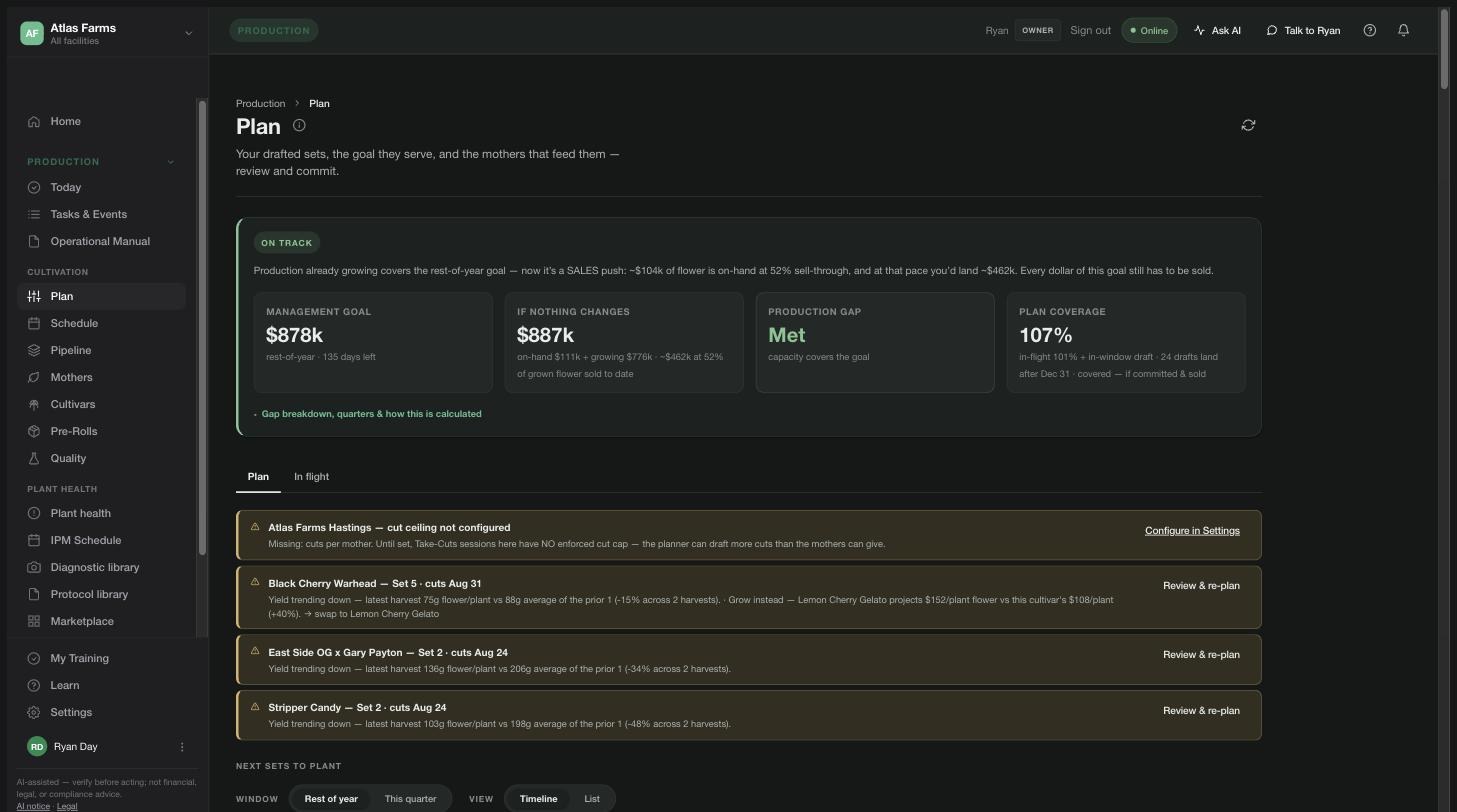
And it argues back. A cultivar trending down gets flagged before it’s planted again — “Grow instead: Lemon Cherry Gelato projects $152/plant flower vs this cultivar’s $108/plant (+40%)” — with the receipts attached.
Every set drafted with its revenue attached.
Every cultivar is graded on yield, grade mix, chemistry, and real revenue. The AI Set Planner drafts every open slot in the rest of the quarter or year against the goal — one click, every number computed from your real data, not generated. Commit a set and it lands on the schedule calendar; take-cuts dates push to the floor.
A plan is only as good as the mothers behind it.
Every planned set needs healthy, mature mothers on the day the cuts are due — so Cannvas tracks what’s available, what’s established enough to cut, and what’s aging out. Mothers run on their own cadence; replacement cuts are scheduled backward from the day the old mother retires, so a planned future set always has viable mothers available.
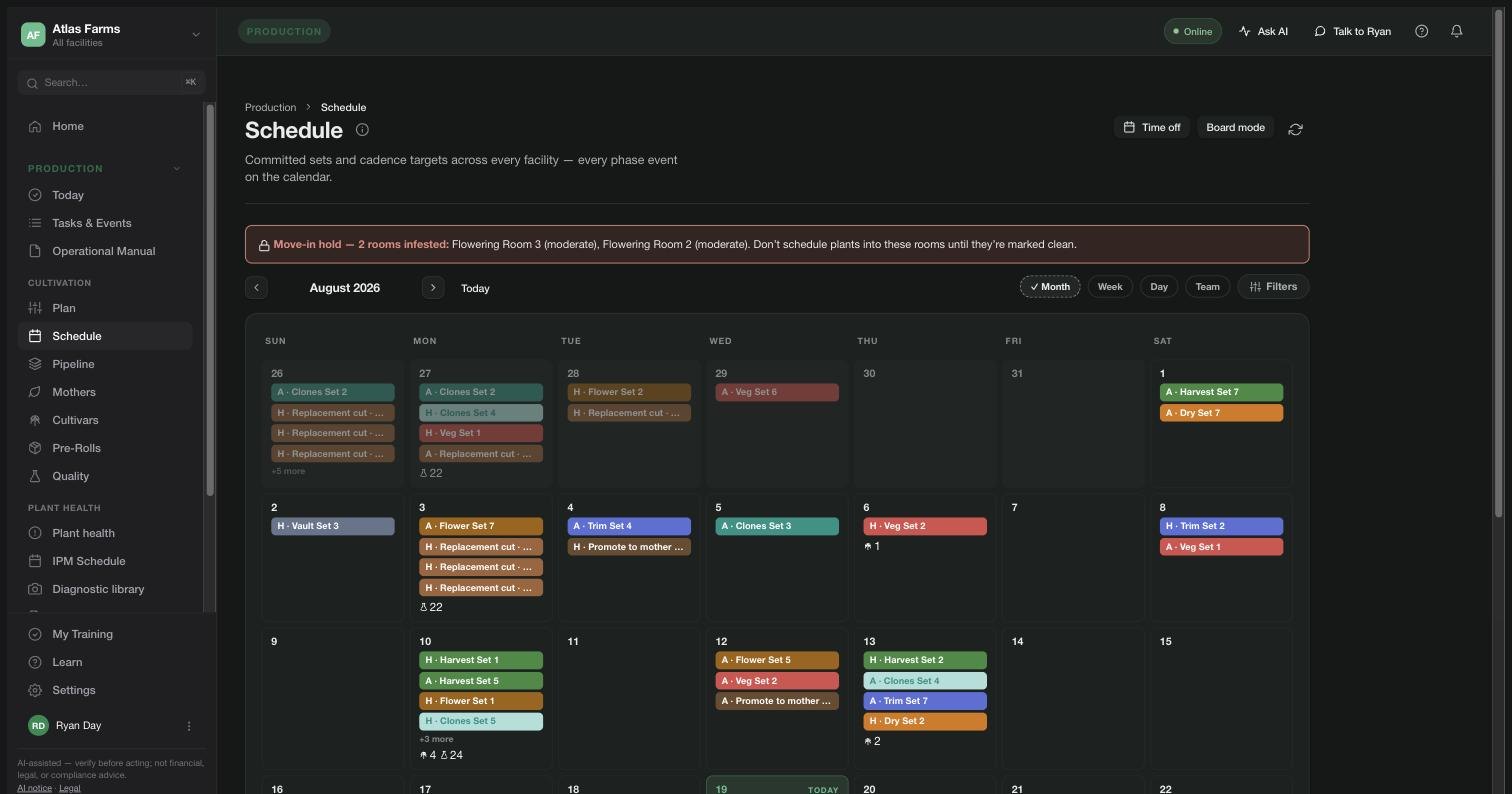
The plan becomes a calendar that defends itself.
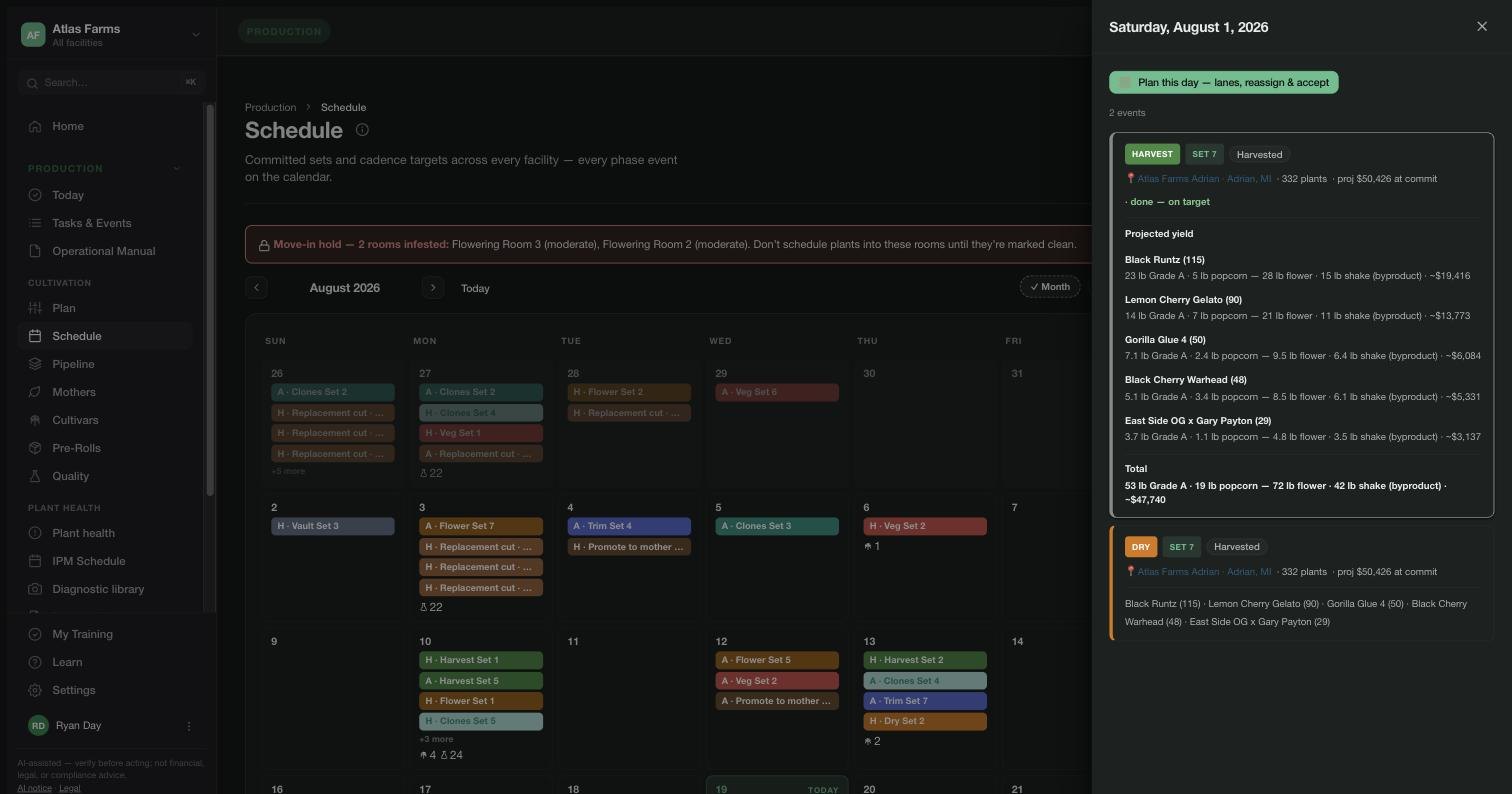
Every committed set lands as phased events on one calendar — cuts, veg moves, flips, harvests, trims, replacement cuts — across every facility, on the fixed cadence the goal was built on. And the calendar knows what the floor knows: infested rooms carry a move-in hold until they’re marked clean. Open any day and the drawer prices it — projected yield per cultivar, grade split, and the dollars committed to that harvest.
Every plant, every room, against its clock.
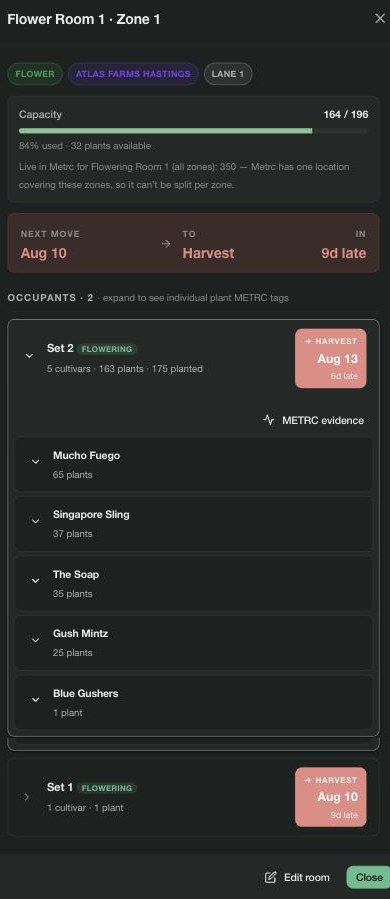
The pipeline is the live answer to “where is everything right now?” — every plant by growth phase and room, each bar displaying its scheduled move date. On-pace rooms read quiet; a room past its harvest date reads red. Open the room and the drawer shows its capacity, its Metrc evidence, and exactly which sets and cultivars are standing in it — down to the individual plant tags.
Consistency is a system, not a hope.
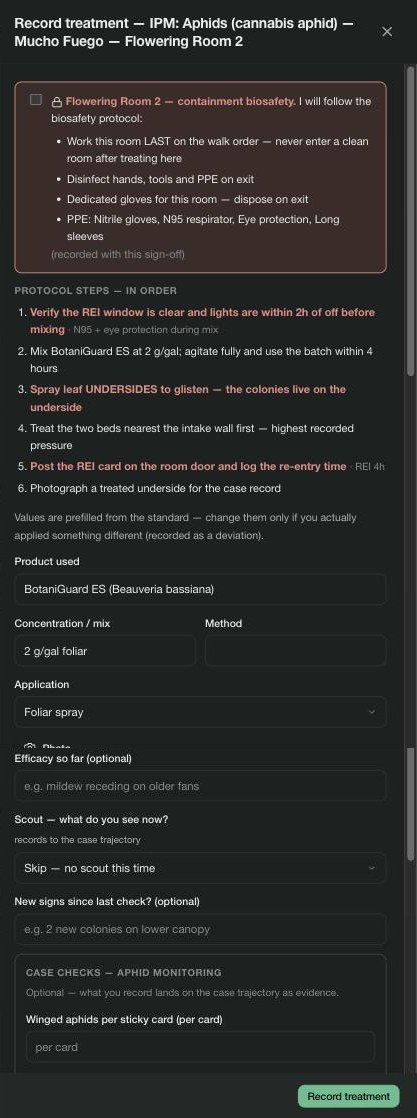
Every daily task is scheduled and assigned — routed to the people most proficient at the work, from the same per-task records the Team Performance page reads — and the day’s tasks land on each person’s phone every morning. Tasks open with the full SOP and the data log beside it; the work is recorded while it happens, and every sign-off is server-timestamped.
Tracked, logged, timestamped. Values are prefilled from the standard — change one and a deviation reason is required. The elapsed time feeds each person’s own baseline, which is what the assignment picker reads tomorrow.
Scheduled eyes on every room.
Scheduled plant-health checks record how each cultivar actually behaves — building phenotype profiles batch over batch — and the moment a check finds pests or disease, it escalates straight to management as a plant-health case with a protocol ready to run. That whole loop has its own page: flag → diagnose → treat → price the damage.
Short four hands on Thursday? Cannvas AI books the crew.
Every duty carries a set point — crew size, role, lead time — so the day plan knows when trim and grade will run short before it does. Today shows the gap; ask Cannvas AI to book the crew and it ranks your contractor bench by availability, reliability and days worked, drafts the work call, and shows you the exact text and recipients. Nothing goes out until you approve. Contractors reply YES or NO from their phones, accept at their rate, and post their availability in the app; Undo withdraws the call.
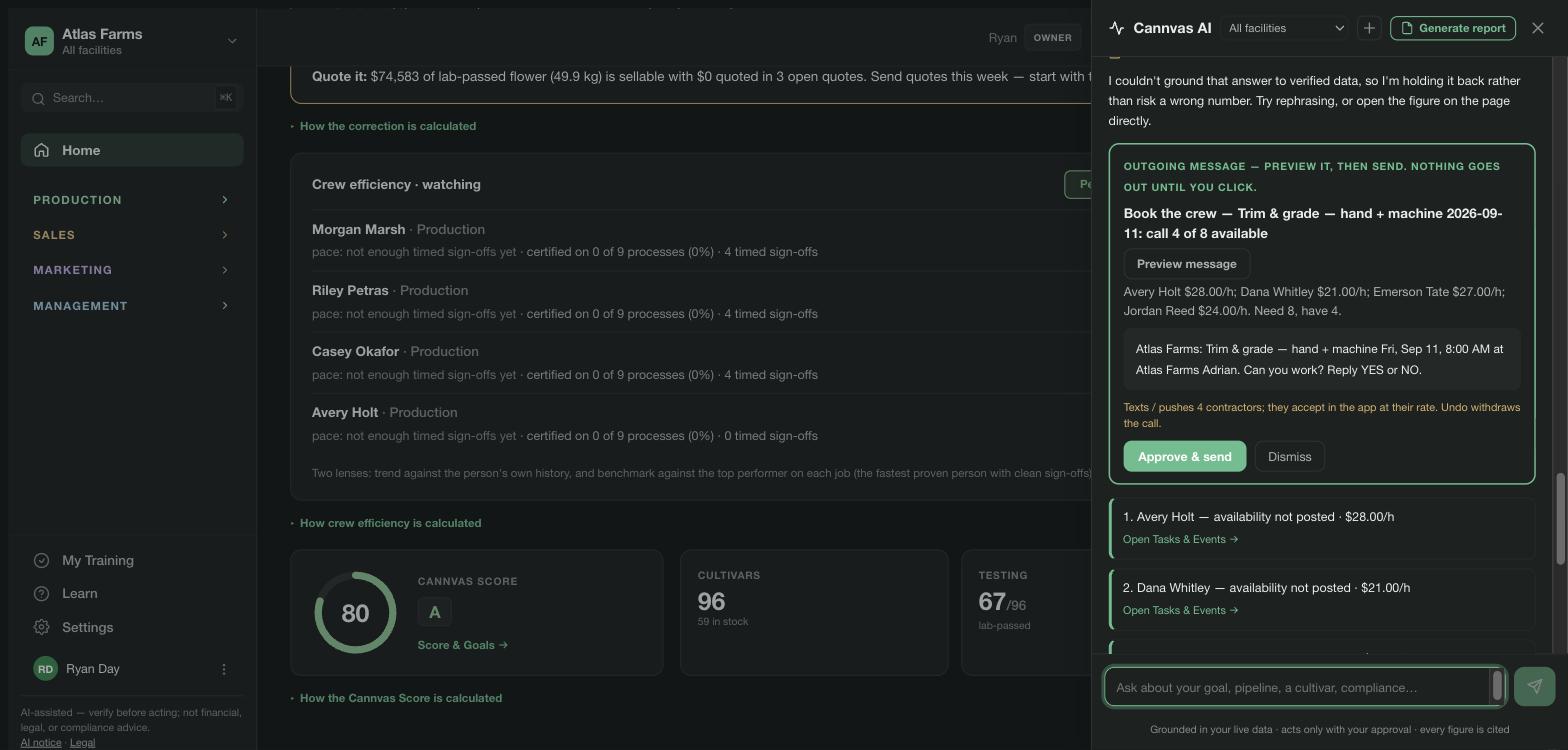
Outgoing message — preview it, then send. Owners can grant this step to autopilot once they trust it; every run is permission-checked, logged as a decision and visible in the Activity log.
Your sensors steer the room. Cannvas scores the outcome.
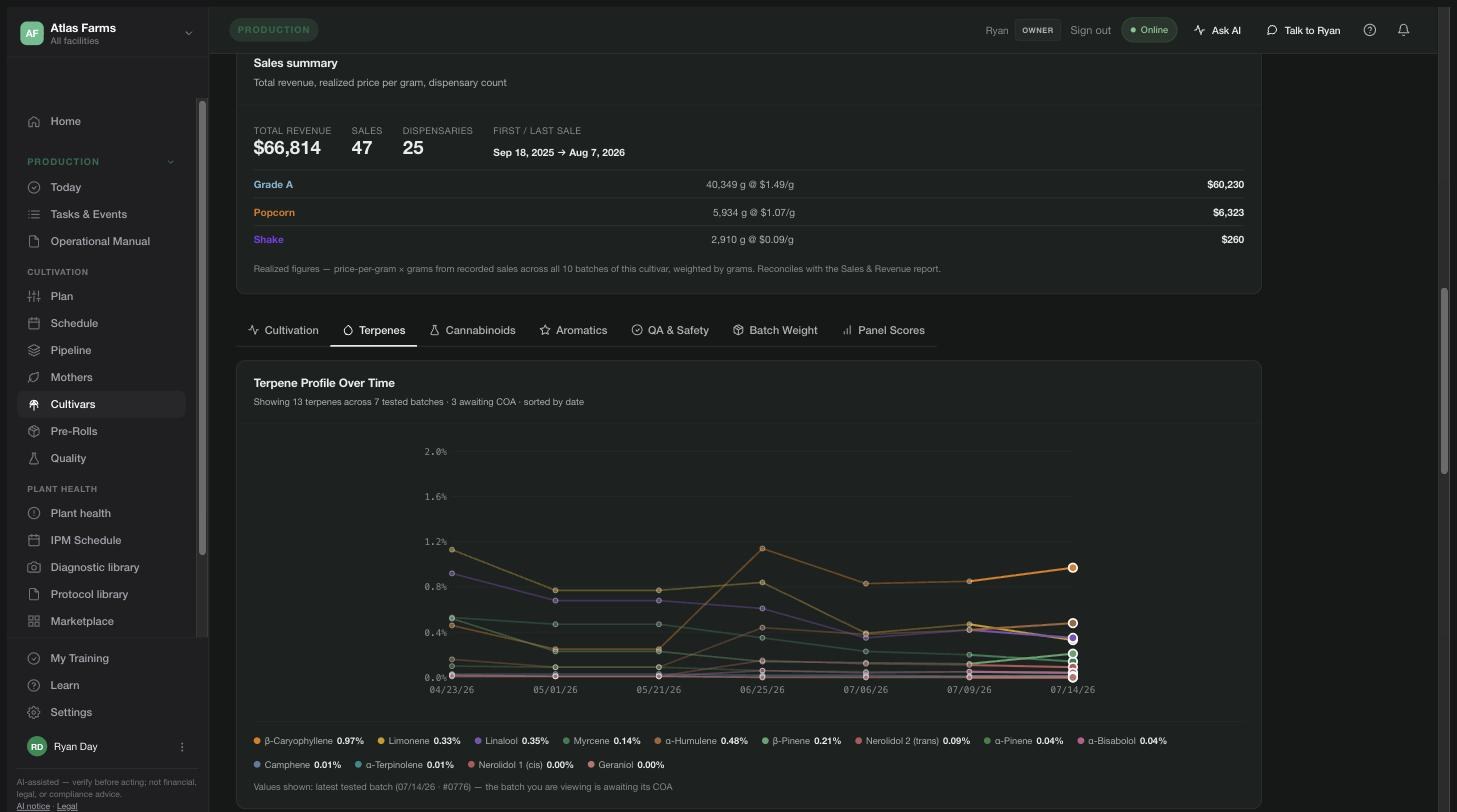
Environmental controls tell you what’s happening in the room. What they can’t tell you is whether the crop got better — so Cannvas tracks every cultivar batch-over-batch across the metrics that matter: terpenes, cannabinoids, batch weight and grade mix, aromatic profiles, smokability, phenotype. Change the VPD or the dry-back program and the next batch’s chemistry and APEX scores answer whether it worked.
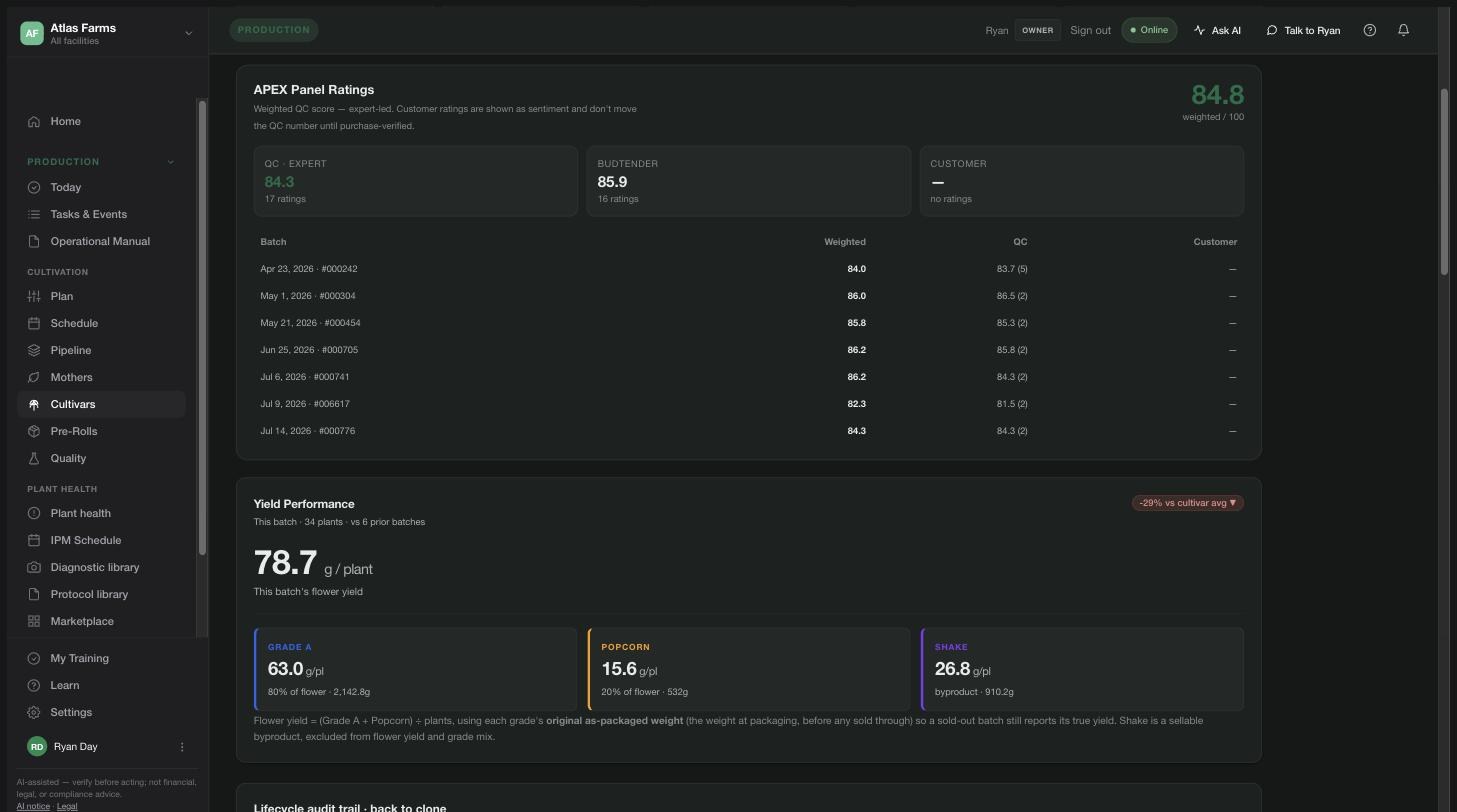
One cultivar, every lens. Terpenes, cannabinoids, aromatics, QA & safety, batch weight, panel scores — the same batch axis under every tab, so a change in the room shows up as a change in the record.
Trending down? It gets said out loud.
A cultivar sliding on any metric is flagged for investigation — on the quality pages, on the Plan before it’s replanted, even on the mother room before a replacement cut is taken. The trail runs all the way back to the mother plant, so a fading line gets caught at the source, not at the sale.

The things that slip — surfaced daily.
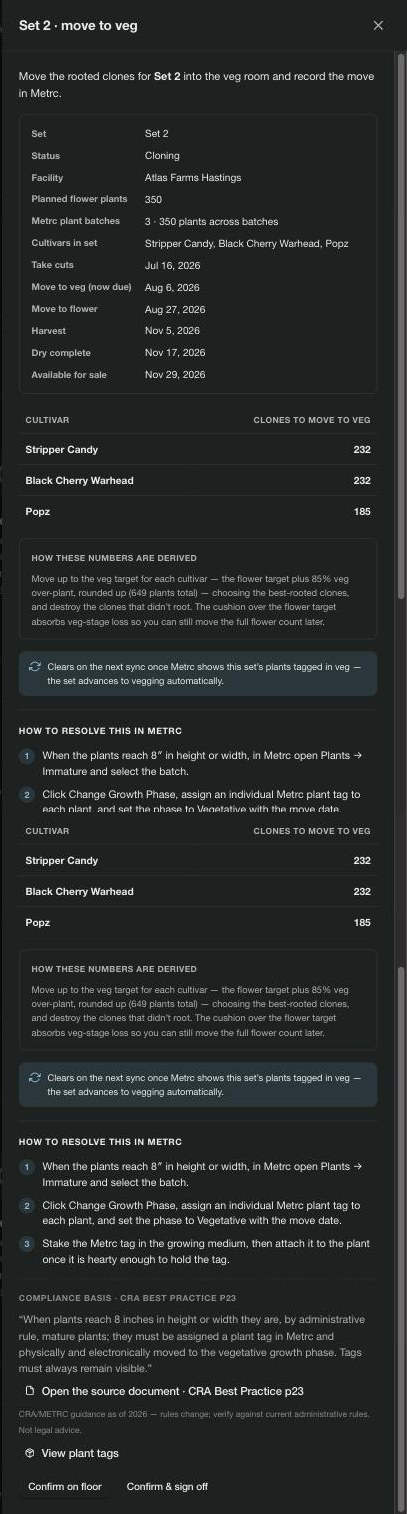
The production command center reads the Metrc mirror on every StashStock sync and lists exactly what would otherwise slip: plants stranded in veg, moves that were never recorded, grade splits required before a sale, lab tests to pass. Every item carries its regulation — and clears itself on the next sync once Metrc reflects the fix.
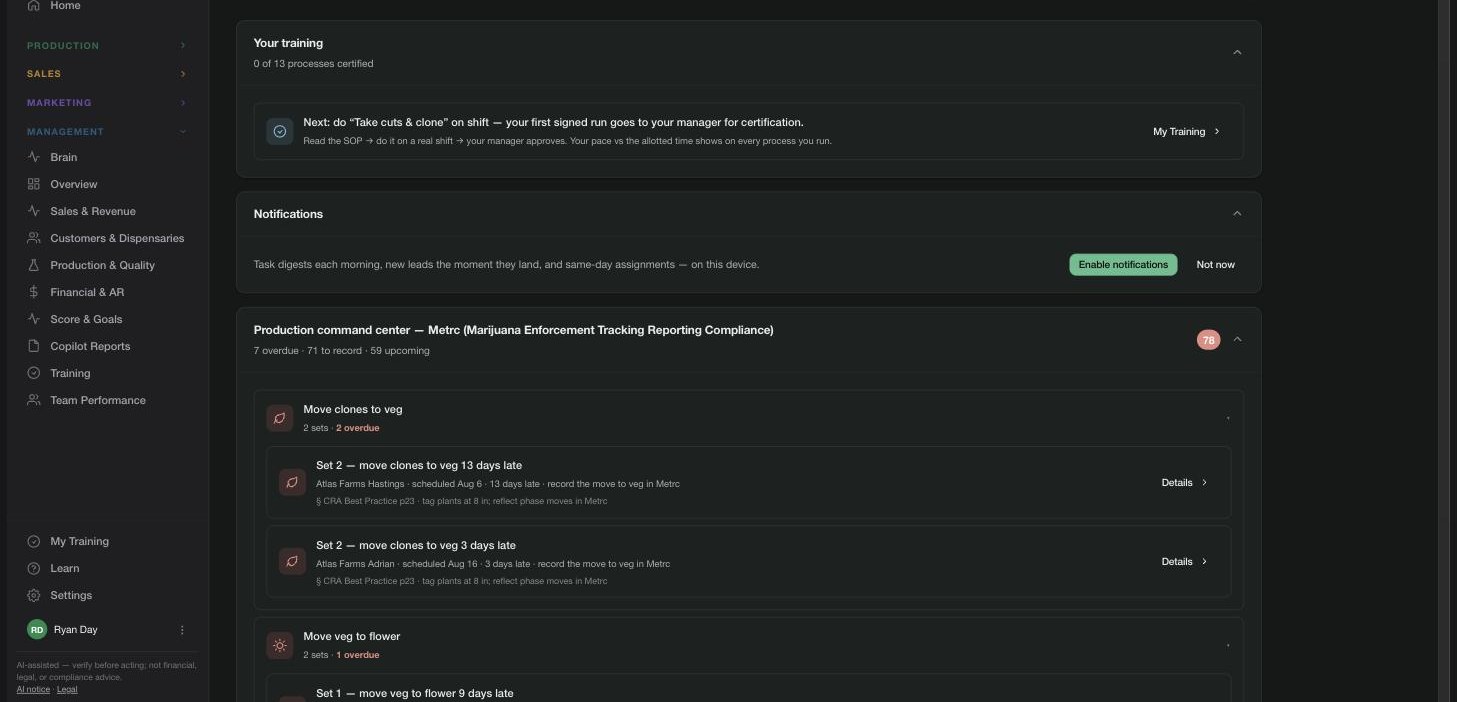
Open the drawer and the fix is spelled out. The set’s full date chain, per-cultivar counts and how they’re derived, the numbered steps to resolve it in Metrc, and the compliance basis quoted from the source document. It clears on the next sync — the mirror is the truth, never a checkbox.
A lab test tells you what’s in it. It can’t tell you how it smokes.
The buyer accepts. The order lands on the floor, ready to fill.
Once a sale is made, everything hands off to production. Acceptance pushes “Order to fill” to the production phones and the order sits at the top of Today: the exact packages to pull whole by tag, the ship check, and the carrier to ask. Each step is signed off by name; the manifest number closes it.


Fifteen senses a COA doesn’t have.
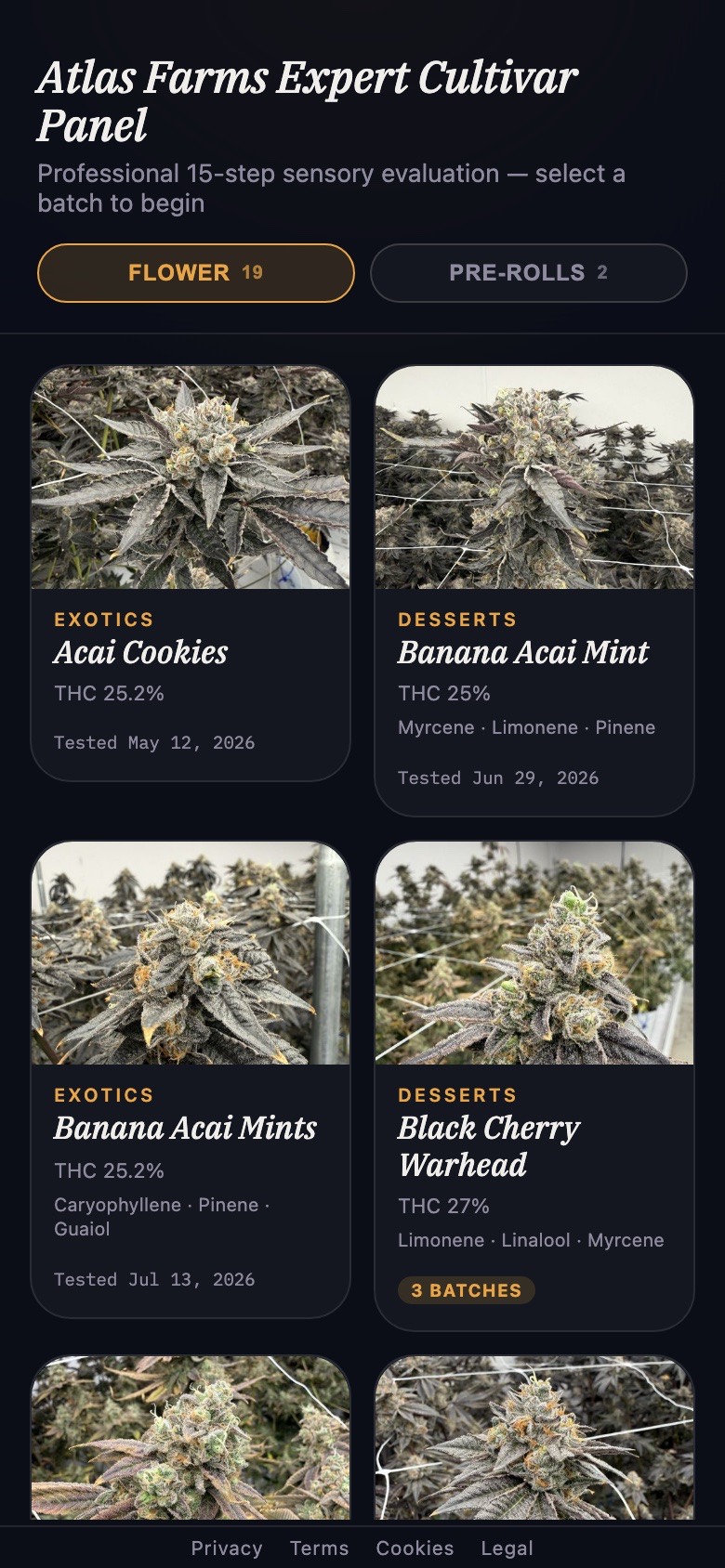
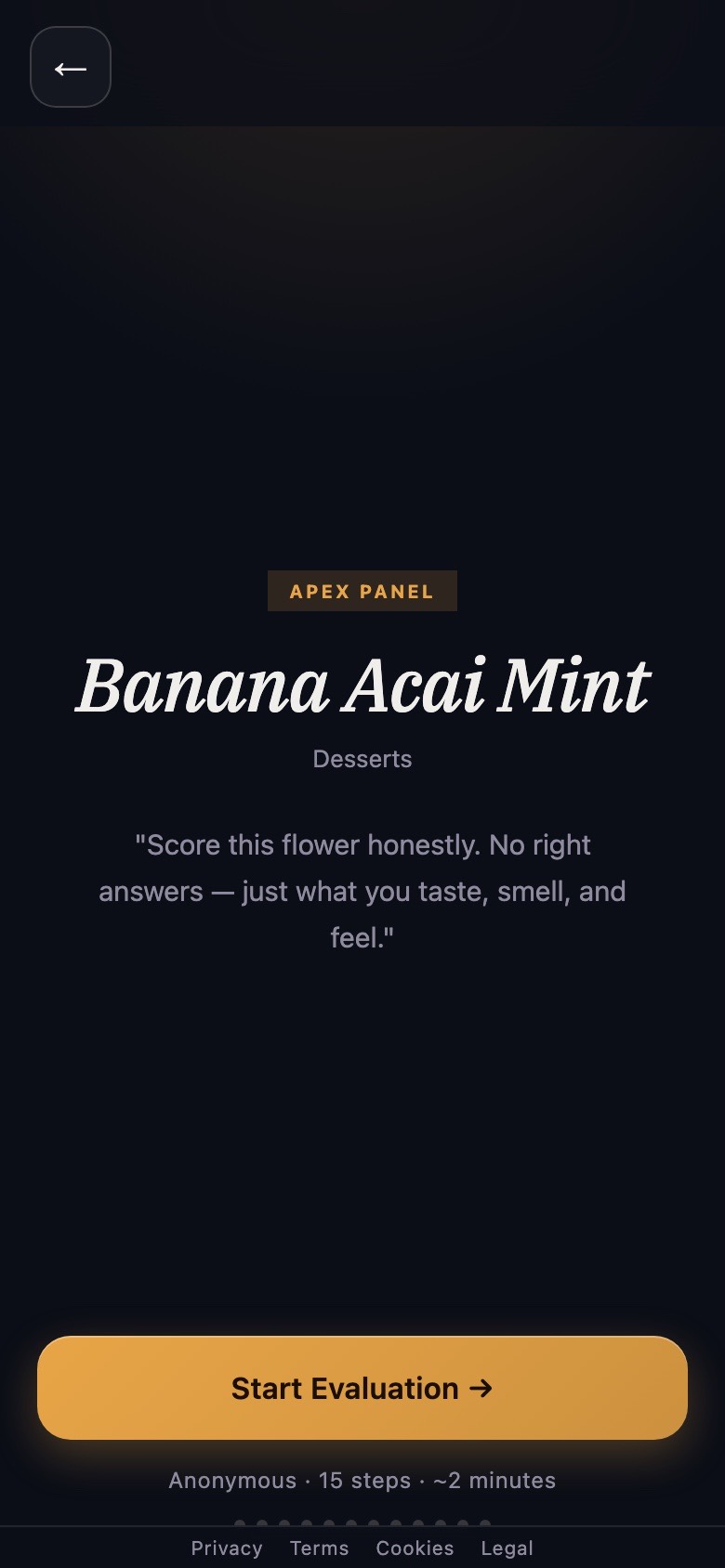
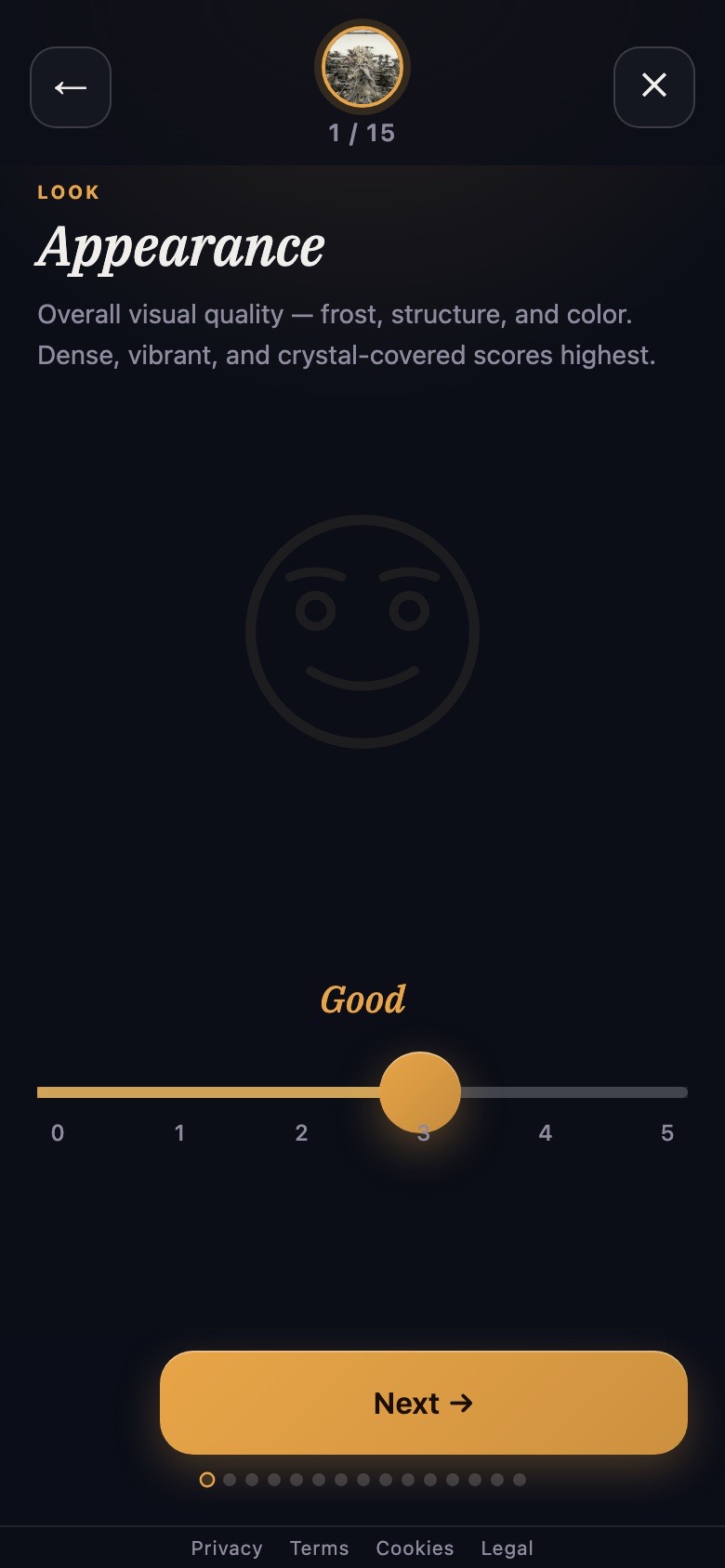
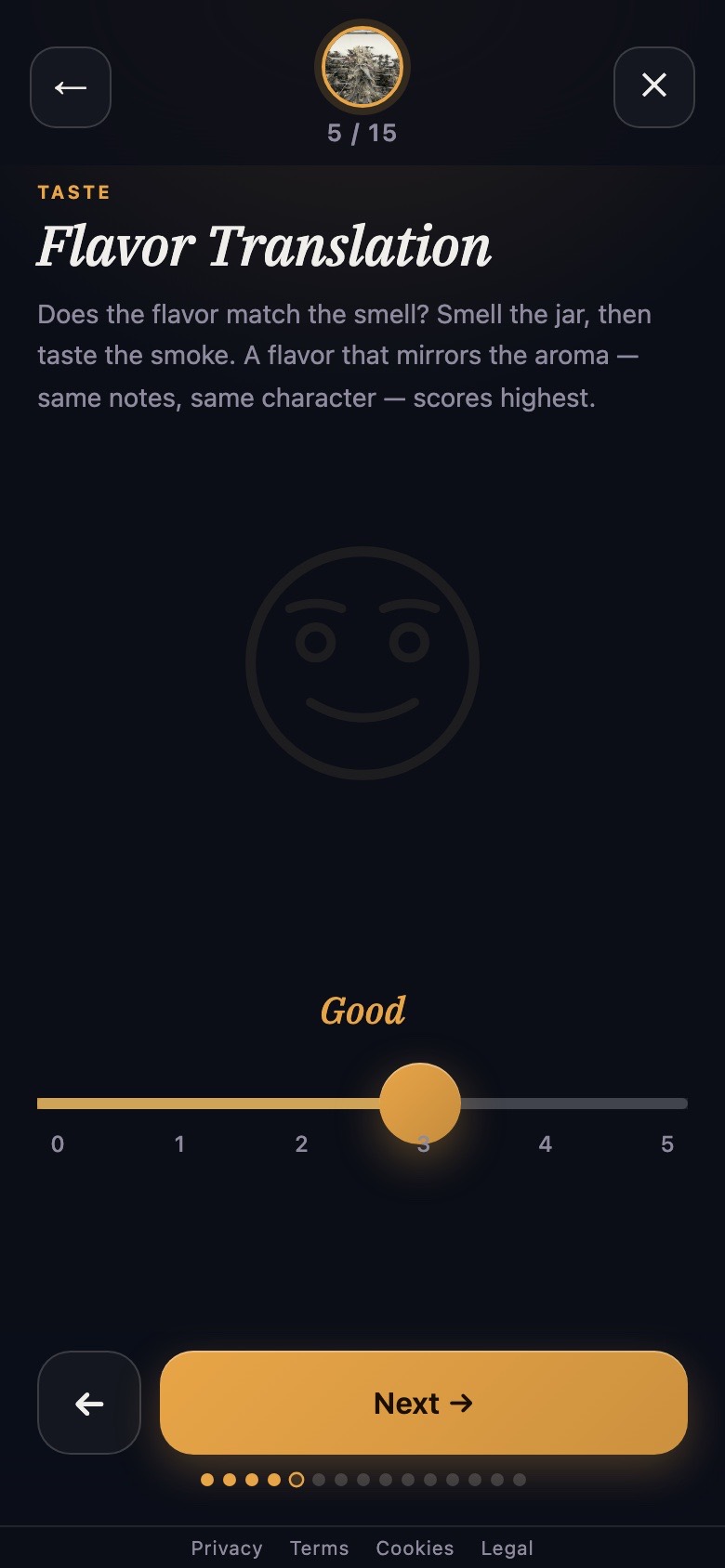
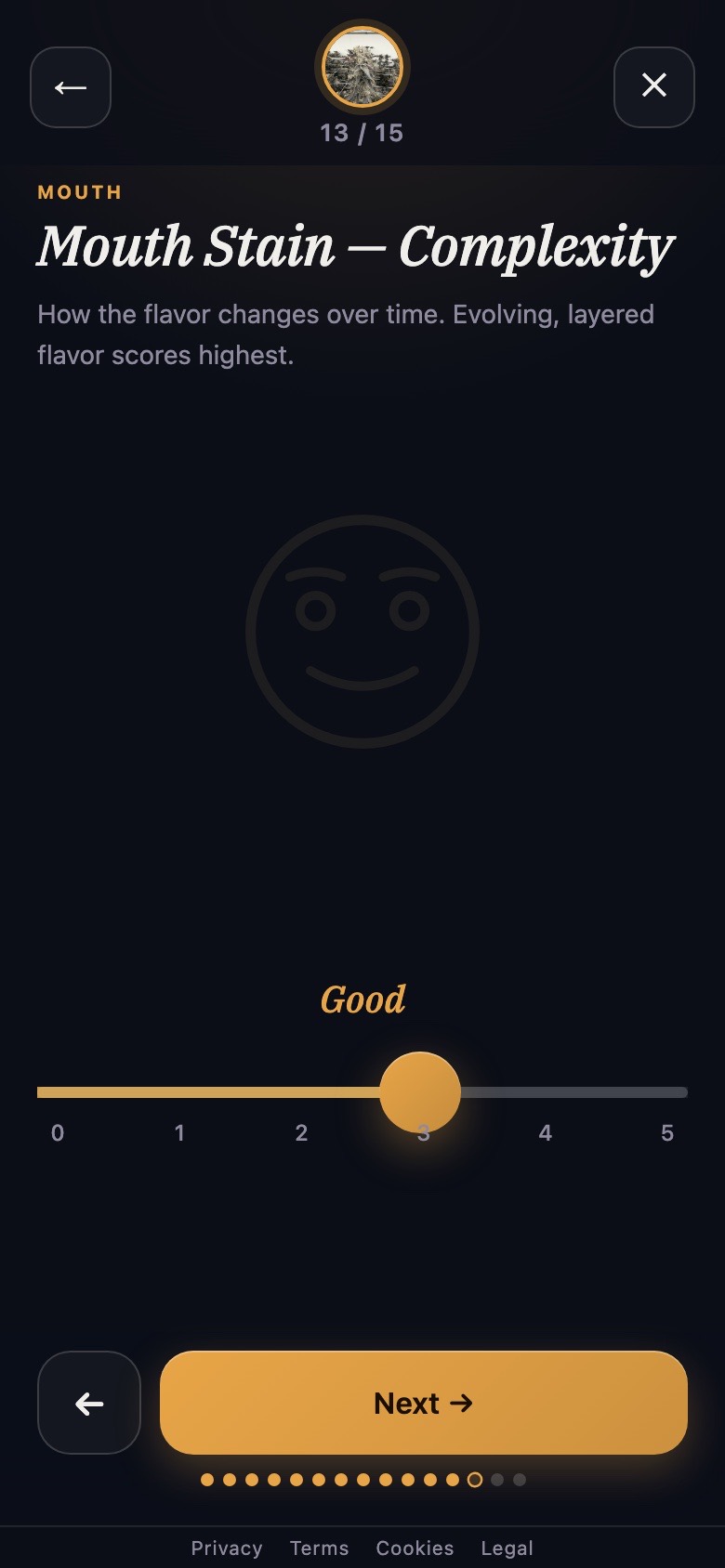
The APEX smokability panel runs fifteen sensory evaluations — look, smell, flavor and whether it matches the smell, smoothness on the throat and lungs, how long flavor and smoothness last, burn, coat, mouth stain, effect — in about two minutes a batch, on your panelist’s phone. Anonymous, no right answers. Expert weight comes only from devices you enroll; anyone else’s score is recorded as customer sentiment. The scores land on the cultivar record next to the chemistry, batch over batch — closing the QA/QC loop and giving your pricing tiers a quality metric buyers can see.
What a COA doesn’t test for is what makes it yours.
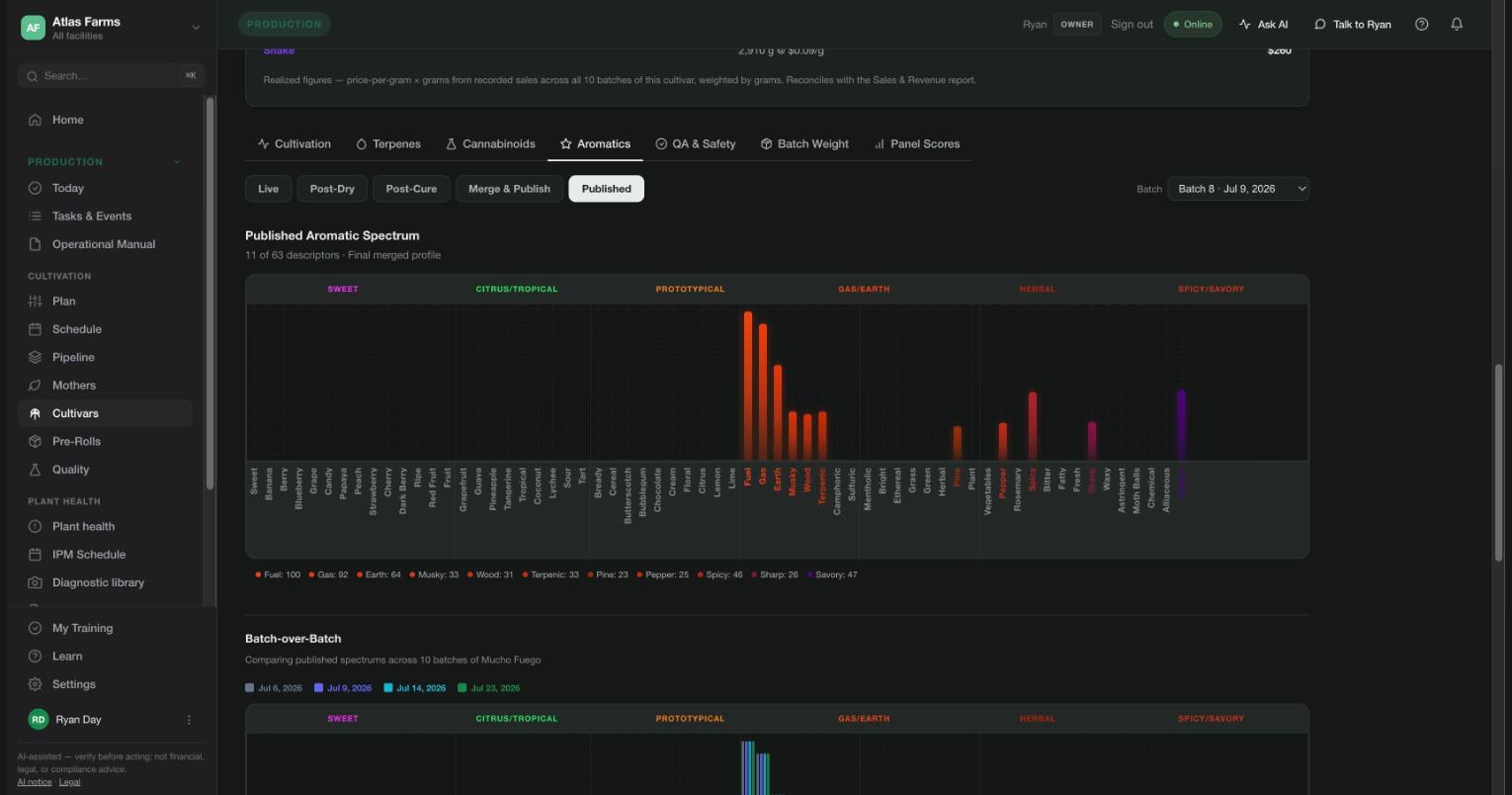
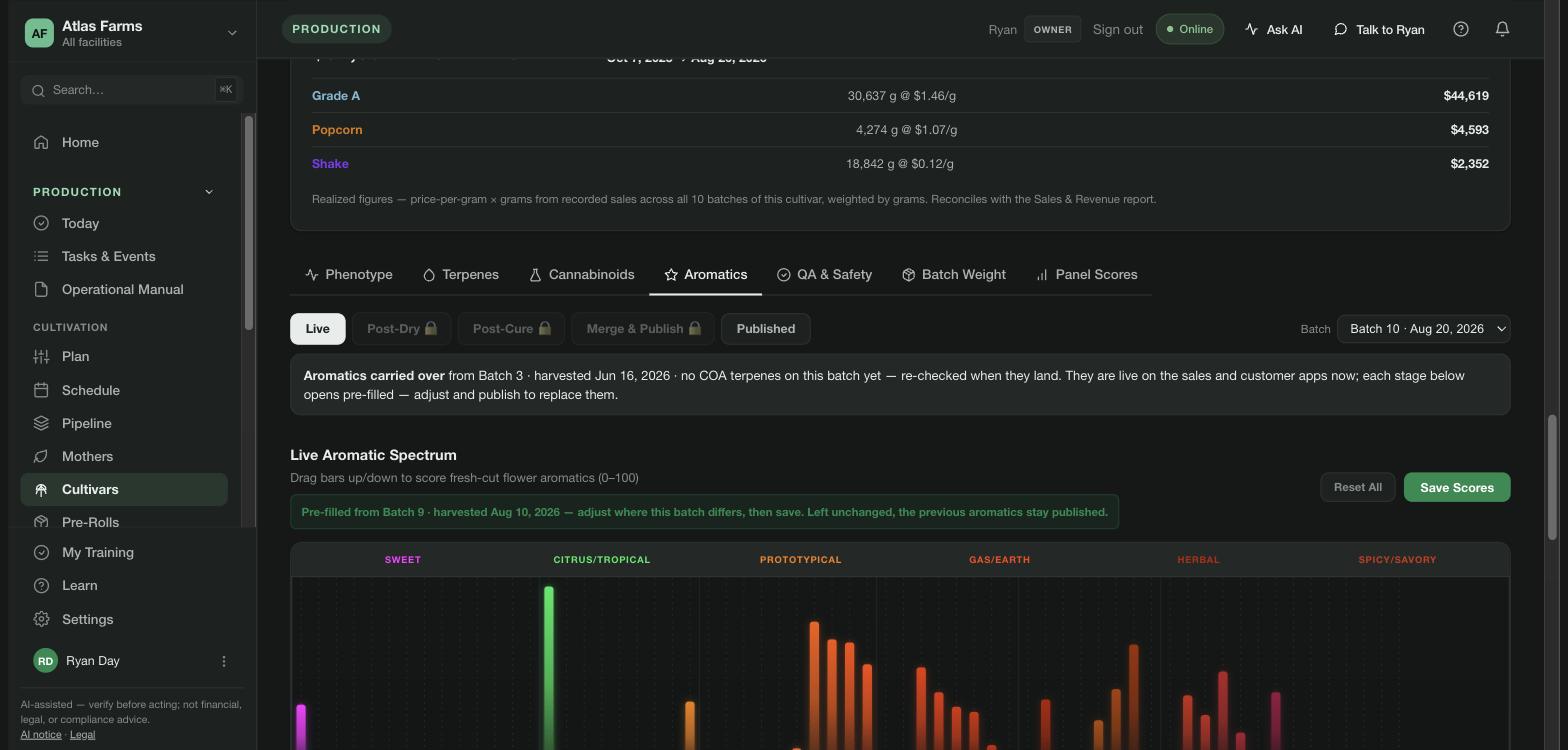
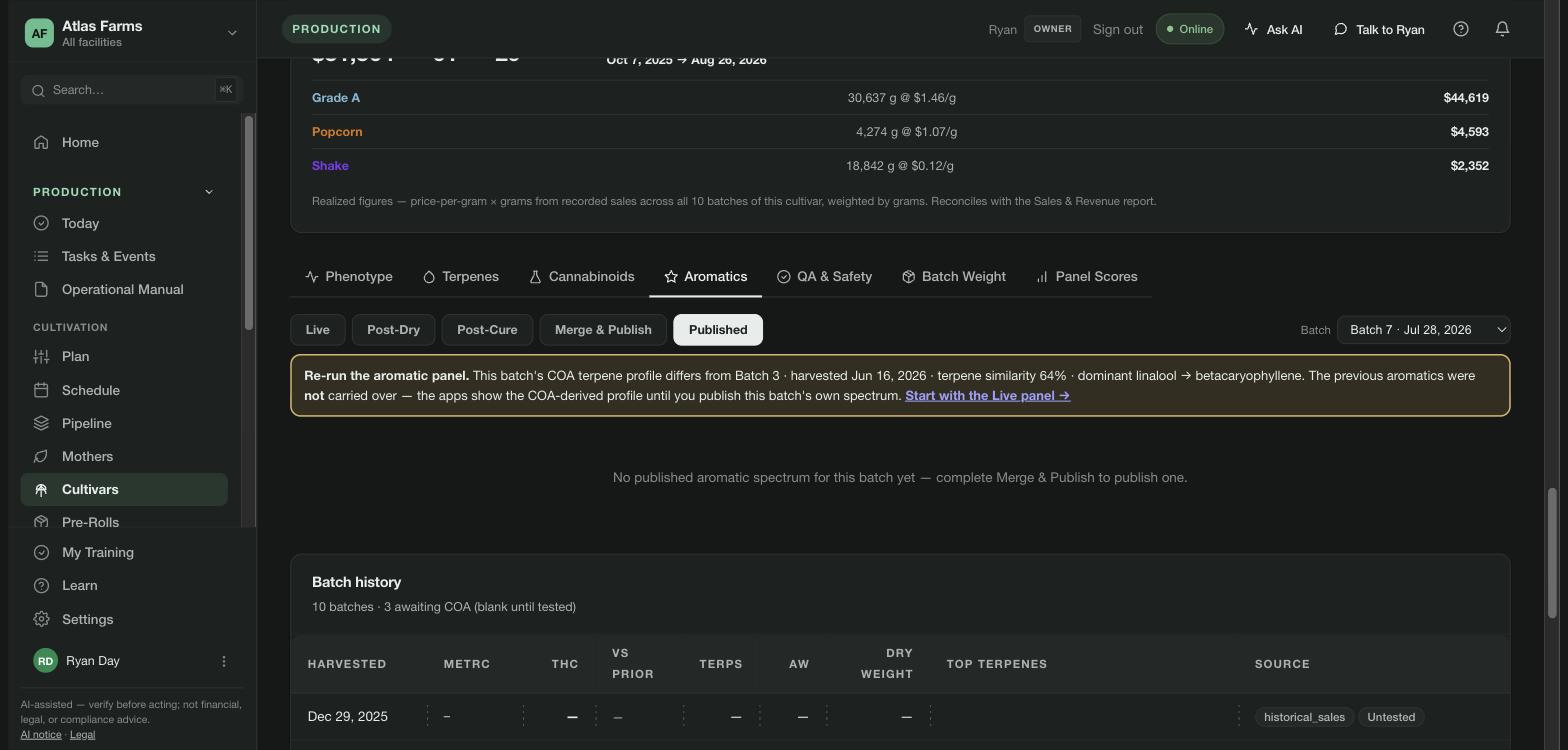
Esters, sulfur compounds, aldehydes — the aromatics that make a cultivar unmistakable are what a standard compliance COA does not report. The spectrum is scored by trained nose at each stage — fresh-cut, post-dry, post-cure — then merged and published, so dry and cure get judged by what they preserve. The next batch of the same strain opens pre-filled from the last: adjust where this cut differs, or leave it and the previous aromatics stay live on the sales and customer apps. When the new COA’s terpenes clearly shift, Cannvas says so and asks for the panel again instead of carrying over a profile that no longer fits.
The goal steers the plan. The batch grades the room.
Sets drafted against the goal with revenue attached · the floor running one way, every time · every batch scored on chemistry, smokability, and the nose — and fed back into what you plant next.
30-minute demo · or the full system on your data, free for 30 days.