Skip to content
1.0 The spine

Plant health should be a system not a scramble.

The preventive calendar is the spine: ten IPM programs running before anything happens. When something does, a floor flag becomes a diagnosed, protocol-backed case in minutes — and the damage gets priced.

All rooms clear — because prevention runs on a calendar.

The command center: every room's status, every open case, and the IPM schedule with every preventive and remediation event across all rooms. Preventive first — remediation is the exception, not the plan.
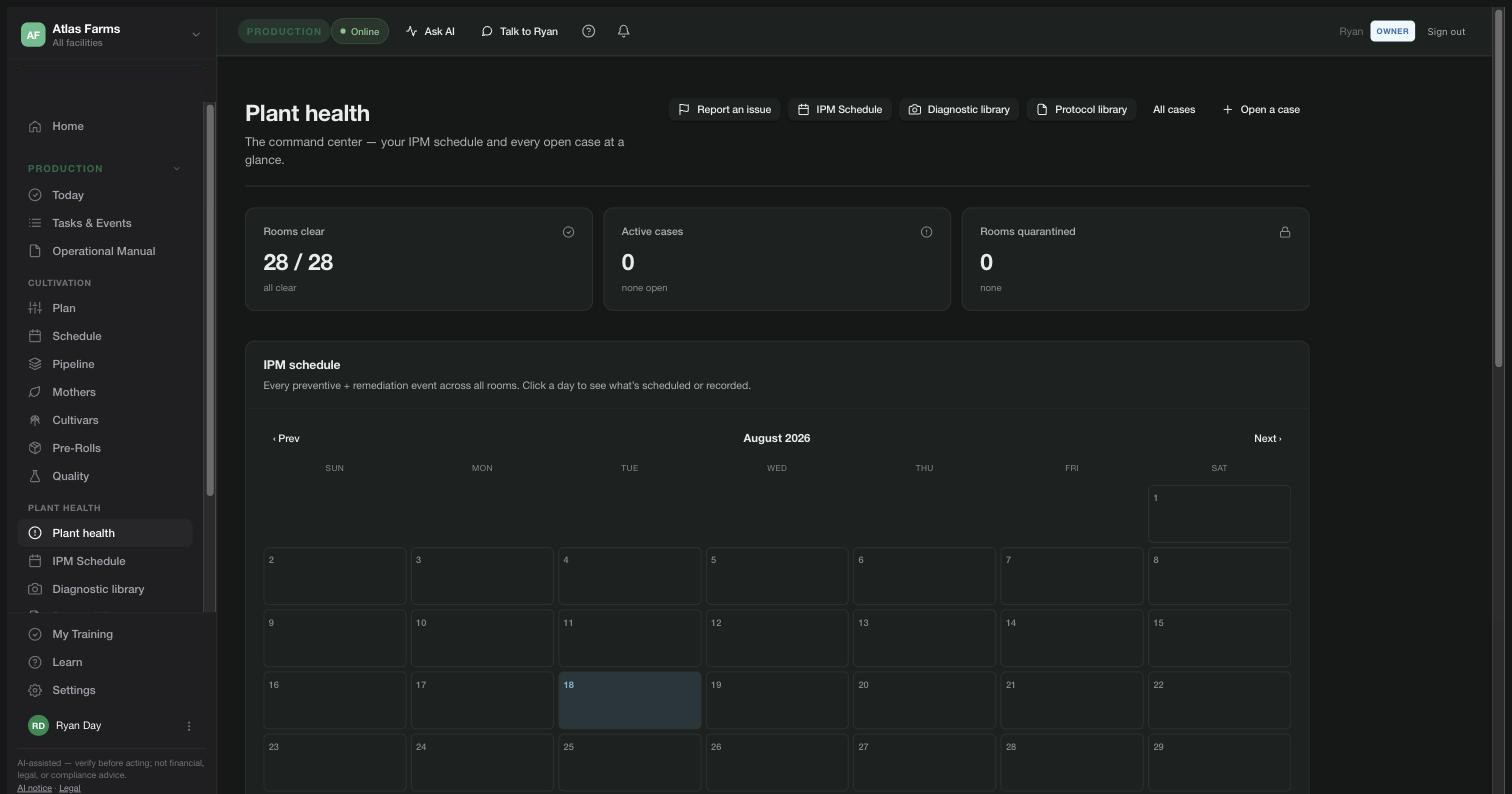
The plant-health command center — 28 of 28 rooms clear, zero active cases, zero quarantined, and the IPM schedule across all rooms

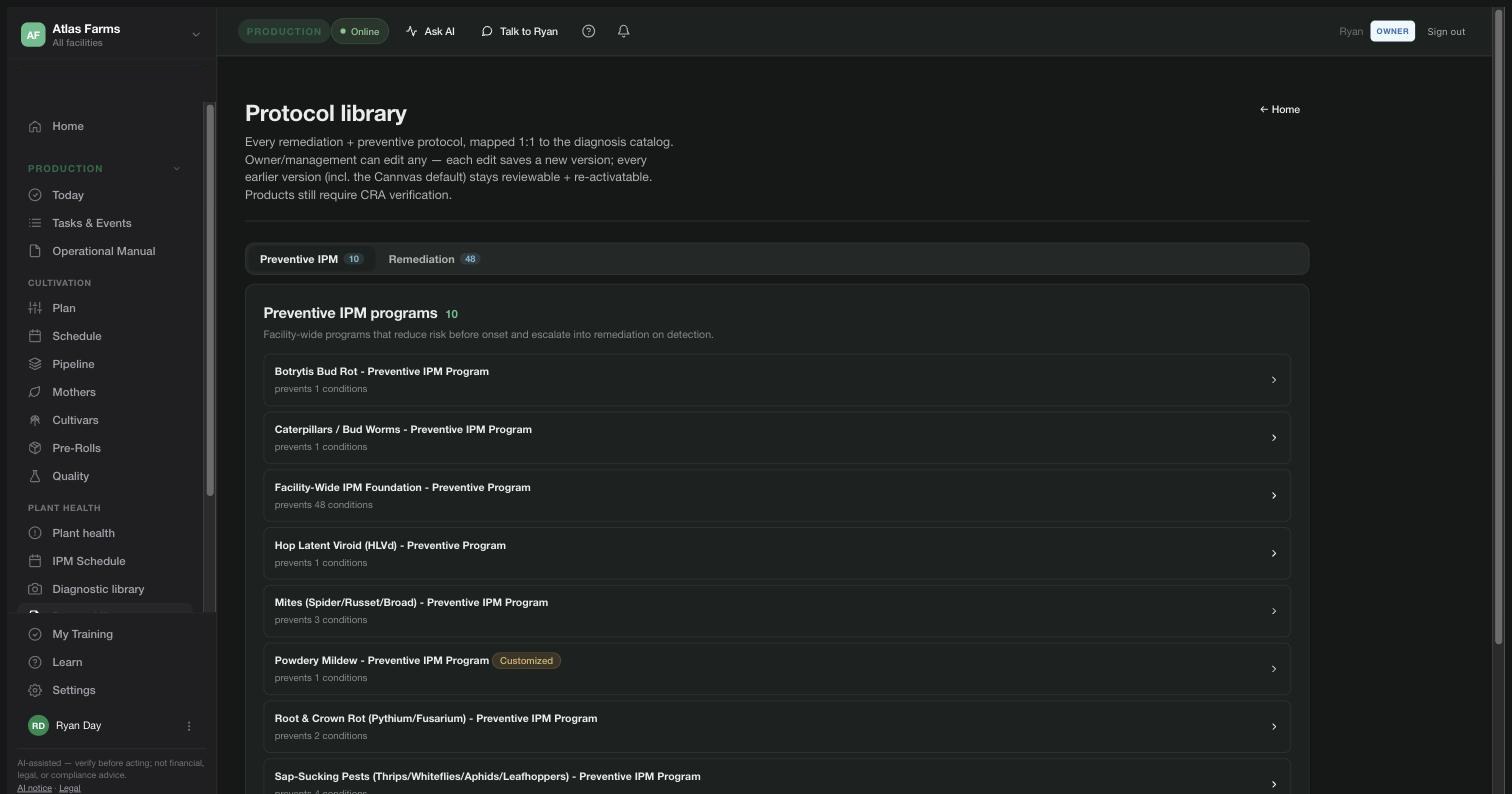
Ten preventive IPM programs, forty-eight remediation protocols — version-pinned, owner-editable, every product CRA-gated. The library below is the playbook; the calendar is the drumbeat.
2.0 The flag

A scout sees something. The system sees it everywhere.

A checked box on a floor walk becomes a flagged health check on the manager's Today page — persistent until reviewed, never lost to a hallway conversation.

Floor walk — Veg Rm 208:42
Moisture checks recorded
No wilt, color uniform
Sticky residue + clusters on leaf undersides — flagged
Manager — Today08:43
Health check flagged — review required
Veg Rm 2 · stays on Today until you dismiss it or open an investigation
3.0 The case

Flag to diagnosis in one sitting. Walk the real case.

Evidence checked against a citation-backed catalog, graded honestly, diagnosed with a confirmation step — and a remediation plan gated behind manager approval.

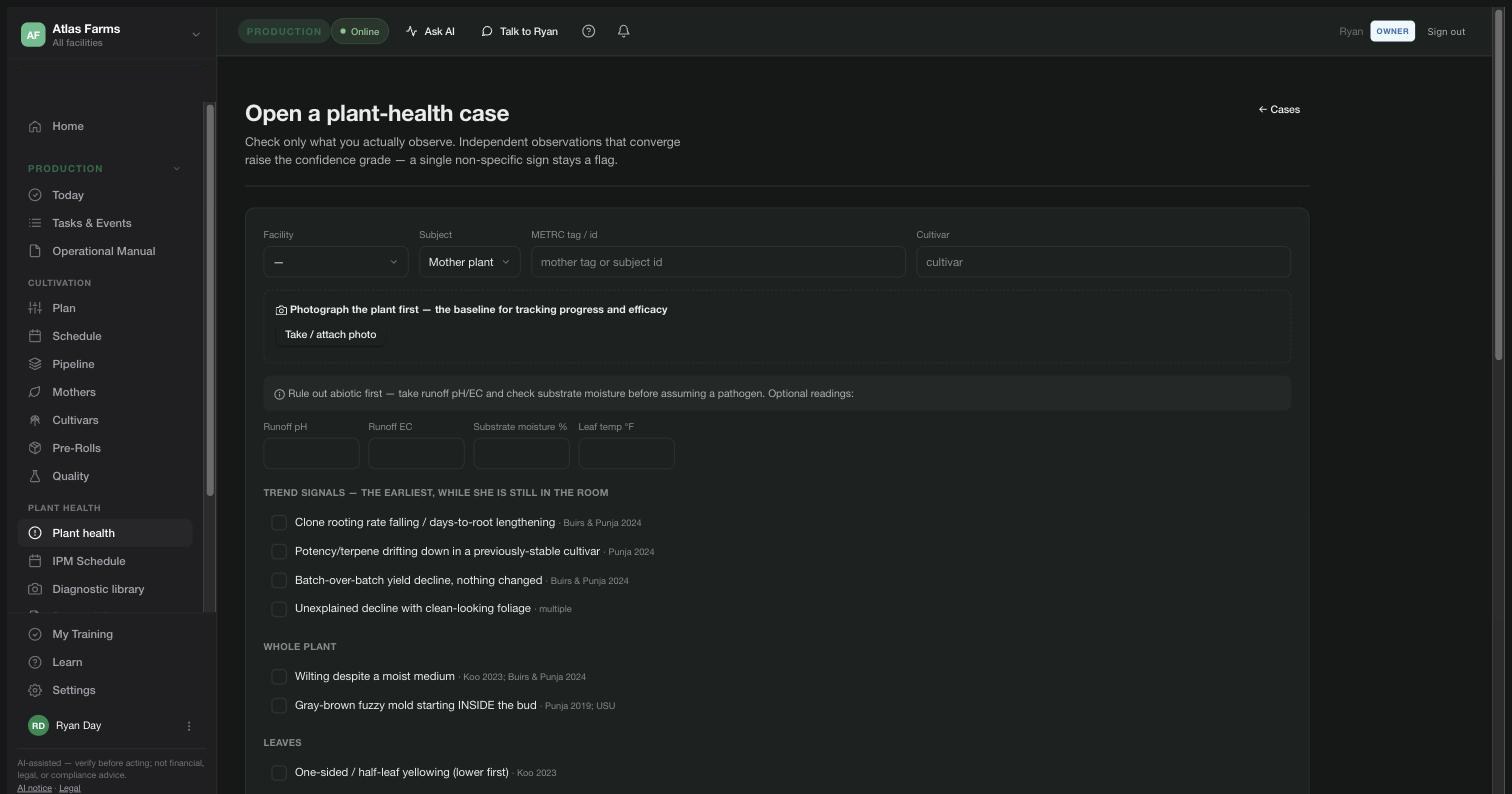
Opening a case — photograph the plant first, rule out abiotic with pH/EC readings, then check only what you actually observe
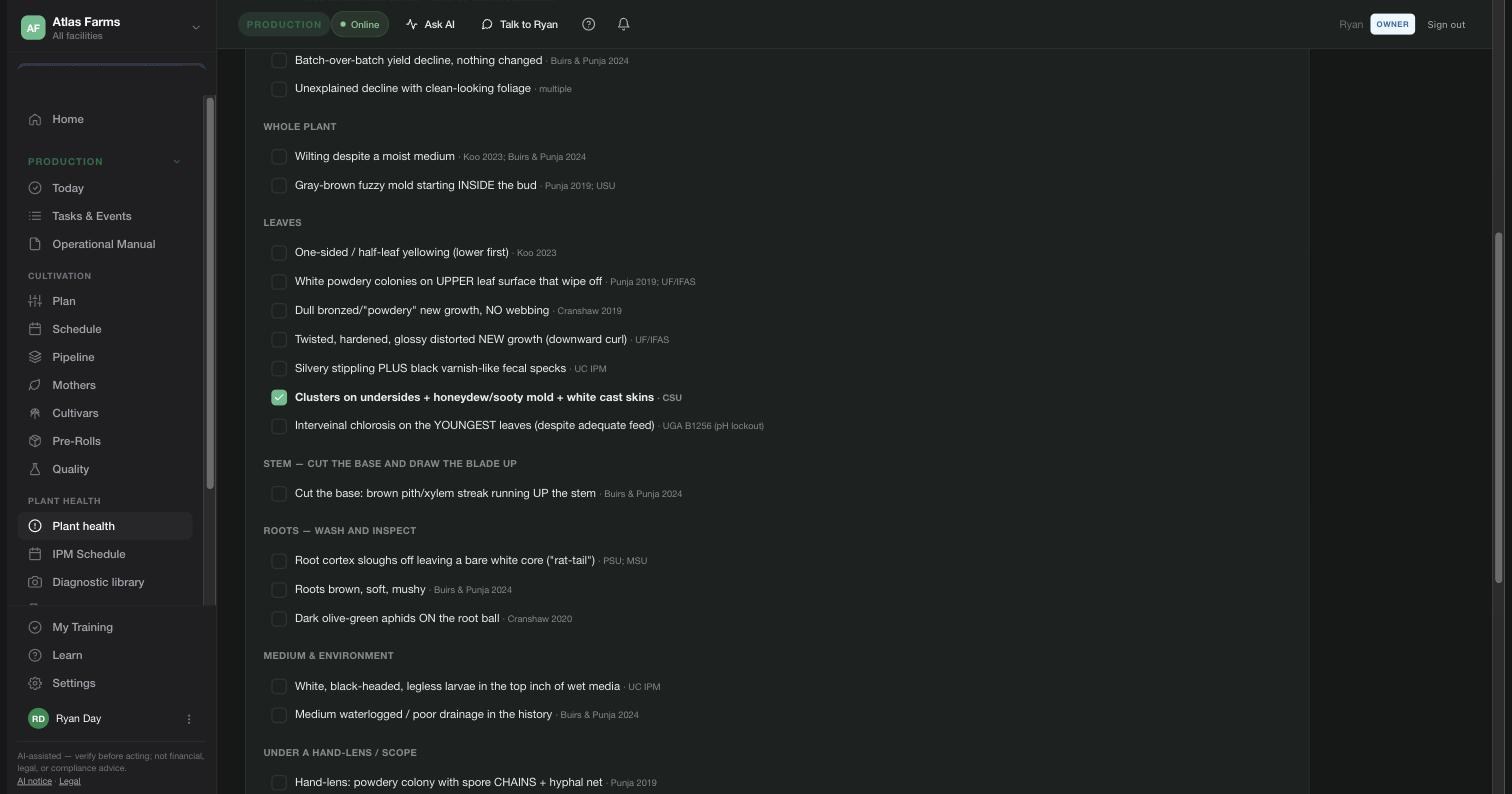
The evidence catalog — every observation citation-backed: leaves, stem, roots, medium, hand-lens; the aphid signature checked
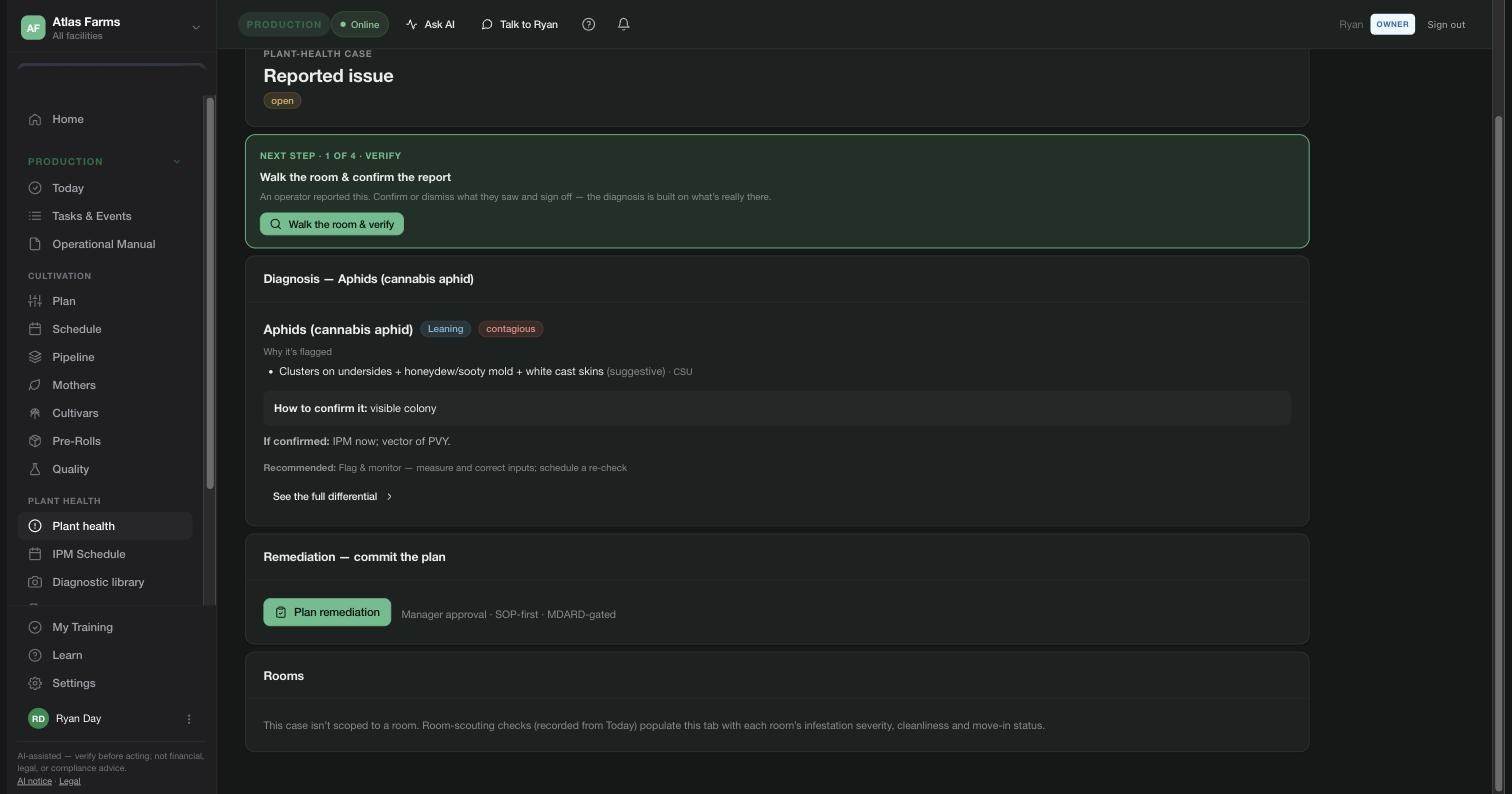
The live case — Aphids (cannabis aphid), graded Leaning, with why it's flagged, how to confirm it, and the walk-the-room verify step
The protocol library — the sap-sucking pest program among 48 remediation protocols, version-pinned and CRA-gated, ready to push to the floor
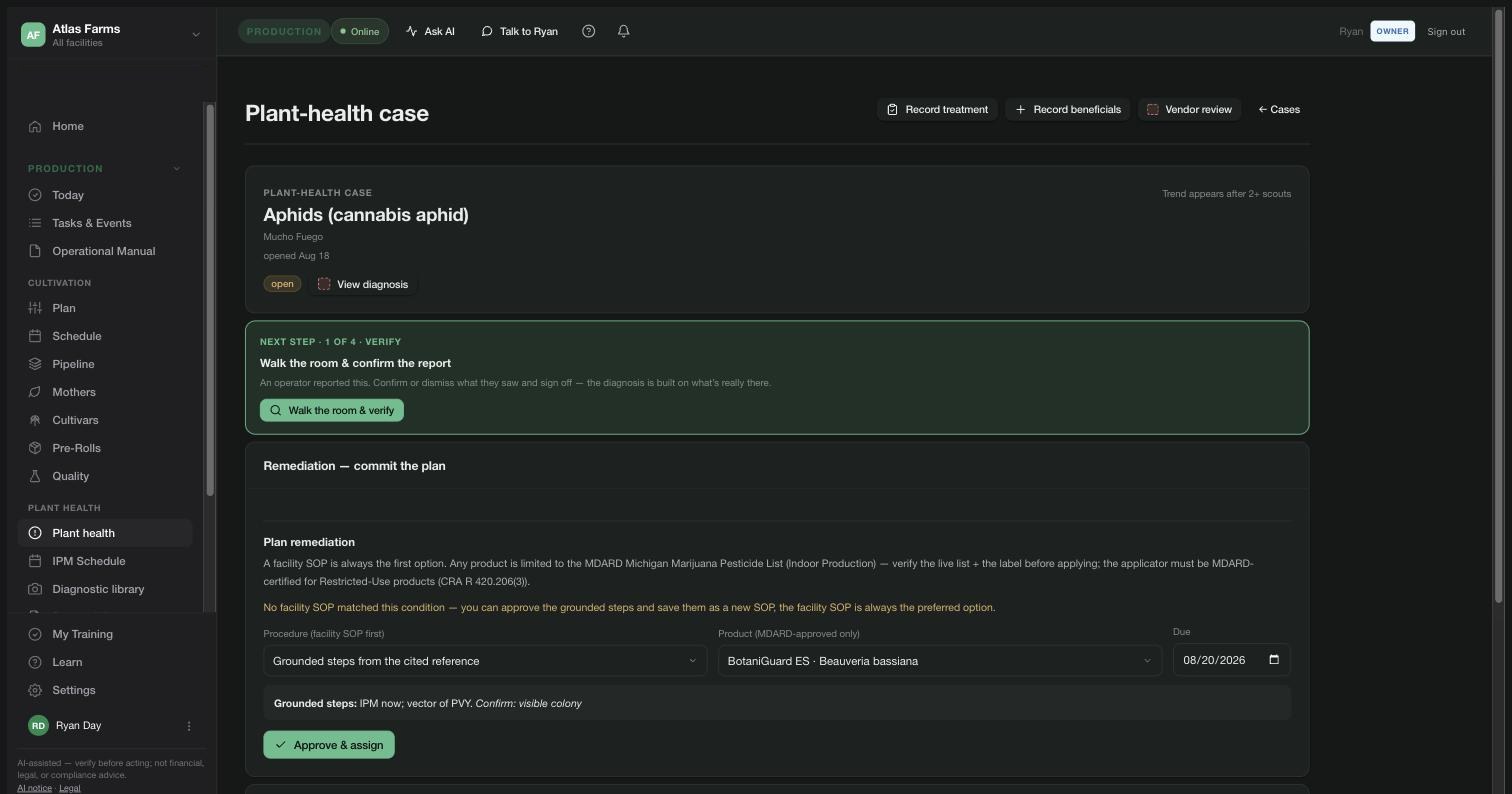
Plan remediation on the live case — product limited to the MDARD Michigan Marijuana Pesticide List, BotaniGuard ES selected at a due date, grounded steps ready to approve and assign

Check only what you actually observe. Photograph first, rule out abiotic with pH/EC — independent observations that converge raise the confidence grade; a single non-specific sign stays a flag.

4.0 The differential

Three hypotheses. Evidence for and against each.

Cannvas never hands the floor a guess dressed as an answer. Every case carries its full differential — what else it could be, what the evidence supports, and what would change the call. Open each hypothesis.

Evidence for

Clusters on leaf undersides with honeydew, sooty mold, and white cast skins — the specific signature (CSU).

Contagious pattern consistent with a sap-sucker; vector risk for PVY if confirmed.

What confirms or kills it

Confirms: a visible colony on the walk-through.

Kills it: no colony found and the residue traces to drip splash — recheck in 48h.

Evidence for

Also produces leaf-surface damage and frass on undersides.

Evidence against

No silvery stippling, no black varnish-like fecal specks (UC IPM) — the thrips signature is absent.

Why it was on the list

Abiotic causes are checked first, by doctrine — runoff pH/EC before assuming a pathogen.

Evidence against

No interveinal chlorosis on youngest leaves; sticky residue is not a nutrient symptom.

The grade is the honesty. "Leaning" means the evidence points but hasn't converged — and the next step is always a human confirming what's really in the room.

4.1 The playbook

Every condition, every protocol — versioned like code.

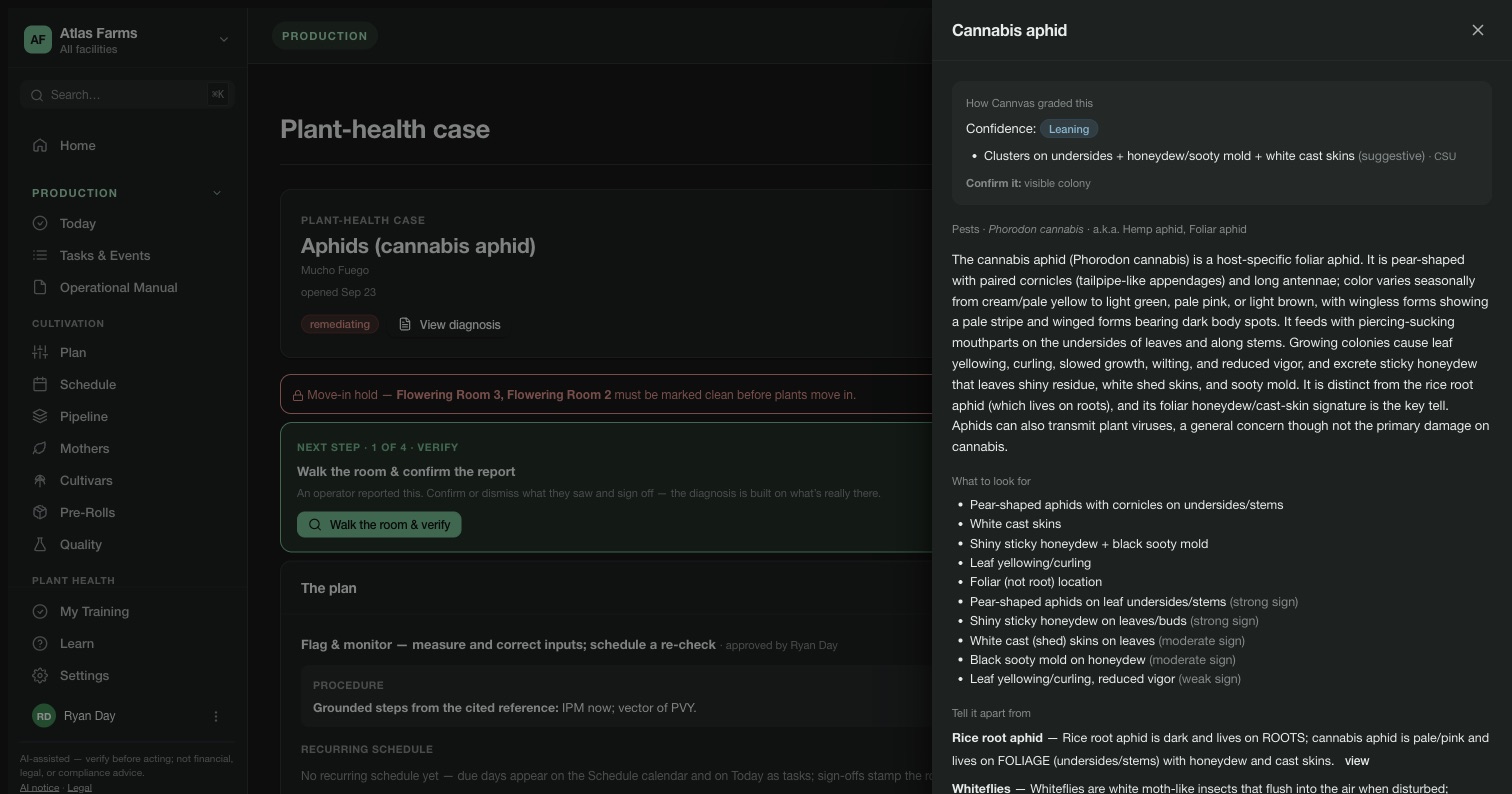
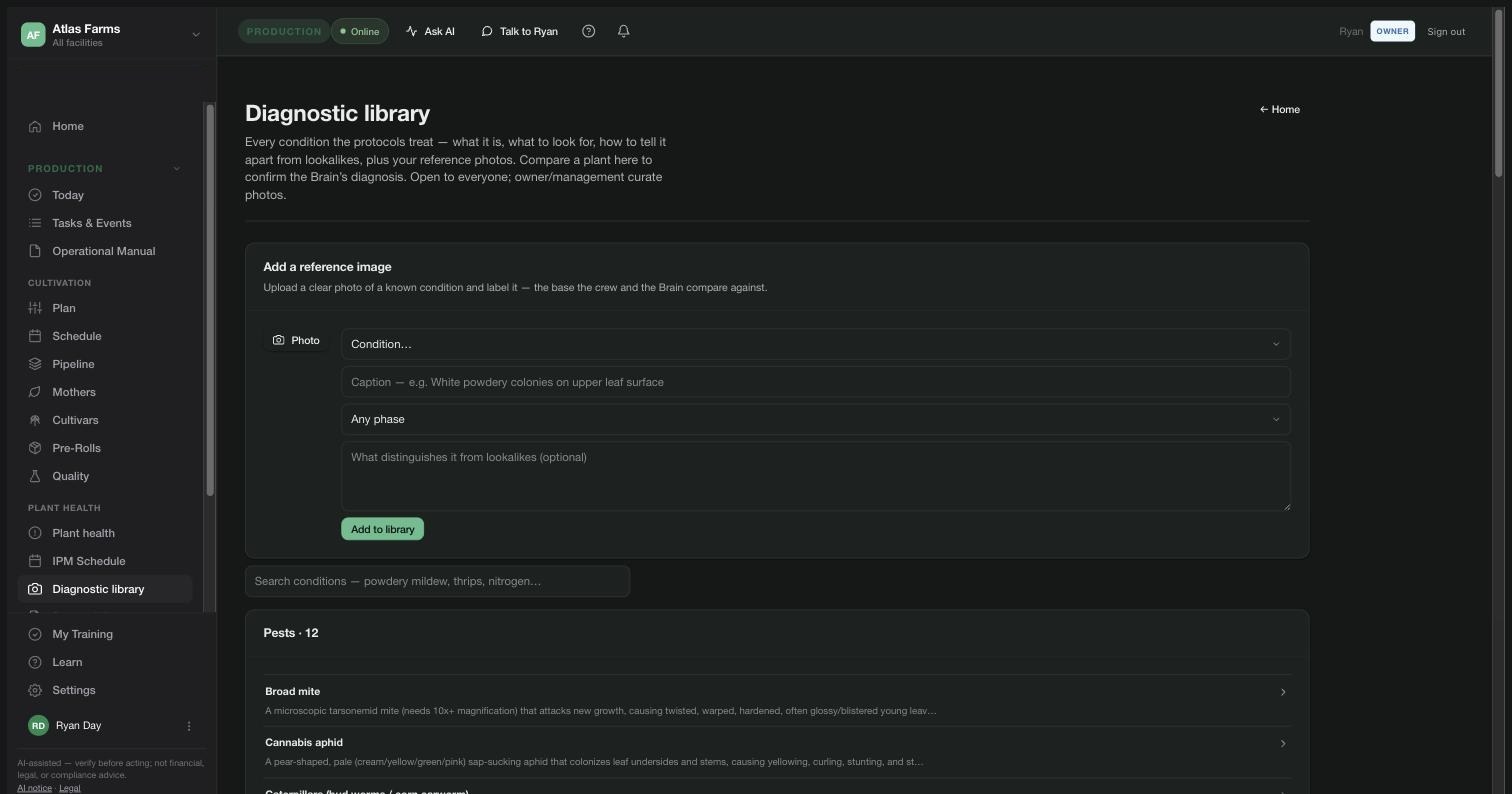
The diagnostic library holds every condition the protocols treat — what to look for, how to tell it from lookalikes, your own reference photos. The protocol library maps to it 1:1; every edit saves a new version, and every earlier version stays reviewable.

The diagnostic library — twelve pests with lookalike guidance and reference photos, from broad mite to cannabis aphid
5.0 The push

Scheduled to the phase. Not to a wish.

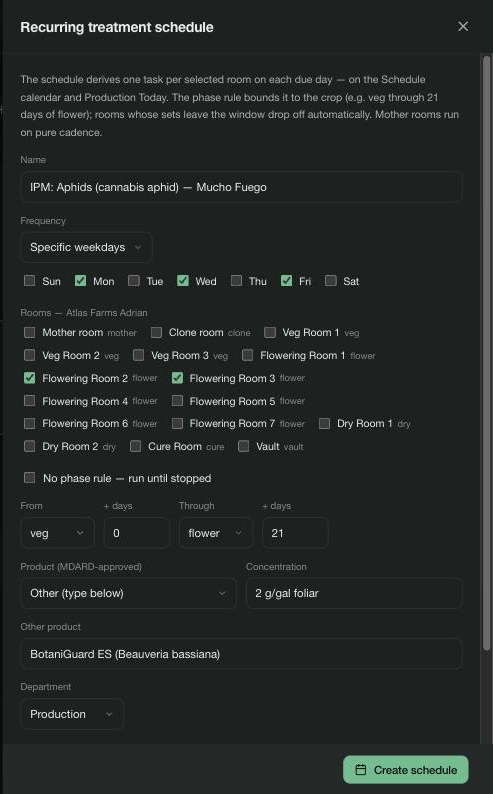
One approval derives the whole campaign: Monday-Wednesday-Friday treatment tasks, one per room per due day, on the Schedule calendar and the floor’s Today. The window is growth-phase aware — veg through day 21 of flower — so rooms whose sets leave the window drop off automatically, and the product and rate ride every task.

The recurring treatment schedule — specific weekdays Monday Wednesday Friday, rooms selected with their phase chips, a phase window from veg through flower plus 21 days, BotaniGuard ES at 2 grams per gallon foliar, assigned to production
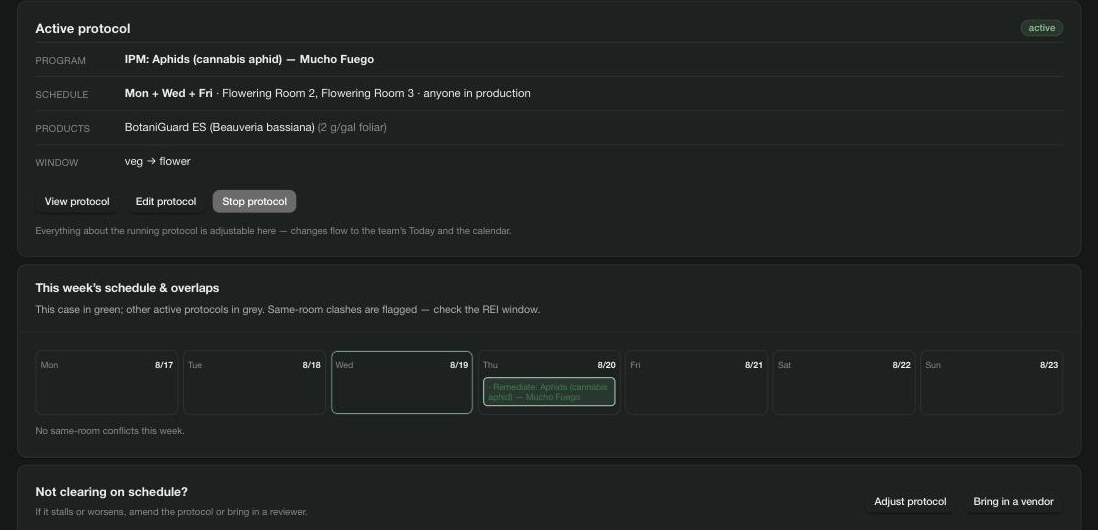
The active protocol on the case — program, Mon Wed Fri schedule across Flowering Rooms 2 and 3, products and phase window, this week's strip with the remediation event placed and no same-room conflicts, and the bring-in-a-vendor prompt

Collisions are checked before they happen. The week strip overlays every active protocol in every room — same-room clashes are flagged against the re-entry-interval window, incompatible treatments never stack, and when it isn’t clearing, bringing in a vendor is one button.

6.0 The floor

Biosafety, steps, records — in the operator’s hand.

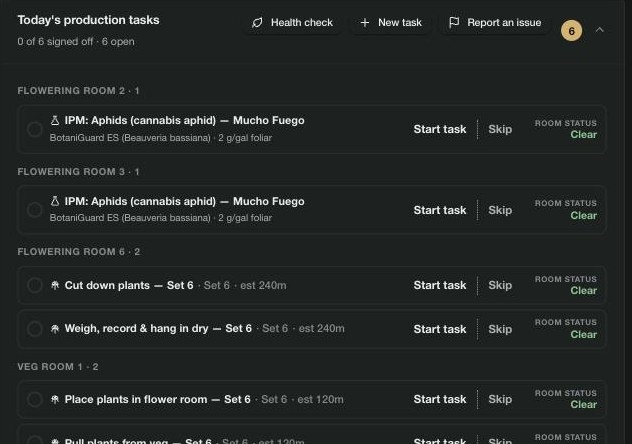
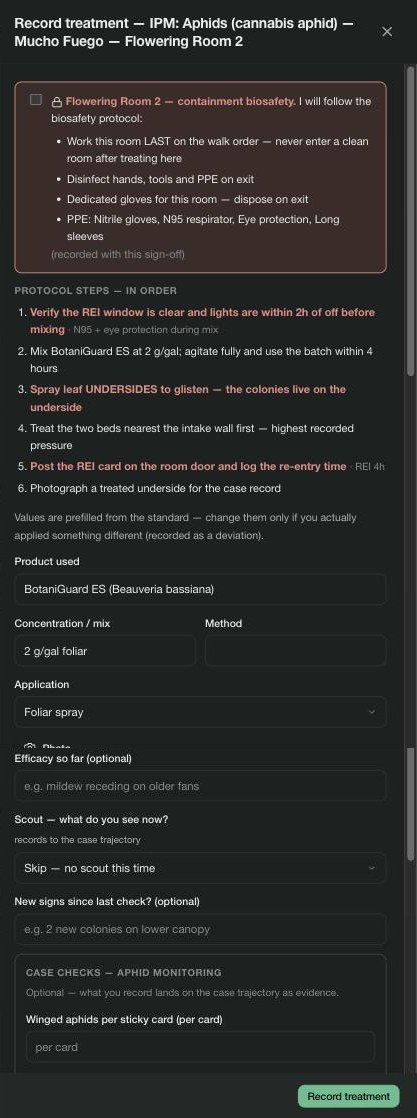
The treatment lands on the floor’s Today beside the room’s live status. Opening it serves everything: the containment biosafety read with itemized acknowledgment, PPE, the ordered steps with criticals highlighted, prefilled standards, photo evidence, and the case’s own monitoring checks — down to winged aphids per sticky card.

Today's production tasks — the aphid treatment in Flowering Rooms 2 and 3 with product and rate on each row, Start treatment buttons, and the room status beside every section

The record is permanent. Values are prefilled from the standard — change one and a deviation reason is required. Every sign-off is server-timestamped and stamps the room, so re-entry lockouts derive on their own. Corrections are amendments, never edits.

The full treatment drawer — red containment biosafety acknowledgment with the itemized protocol recorded with the sign-off, six ordered protocol steps with criticals in red and REI callouts, prefilled product and concentration, foliar application, photo control, efficacy and scout fields, and the aphid monitoring case check counting winged aphids per sticky card
FLAGGED ON THE WALKA floor check becomes a case in minutes.
TREATED ON CADENCEEach application lands as a marker on the trend.
THE TREND JUDGESLater checks score the treatment, not a hunch.
CLEARED → PREVENTATIVEWhat worked joins the IPM calendar, logged effective.
6.1 The open case

Every action lands in one ledger.

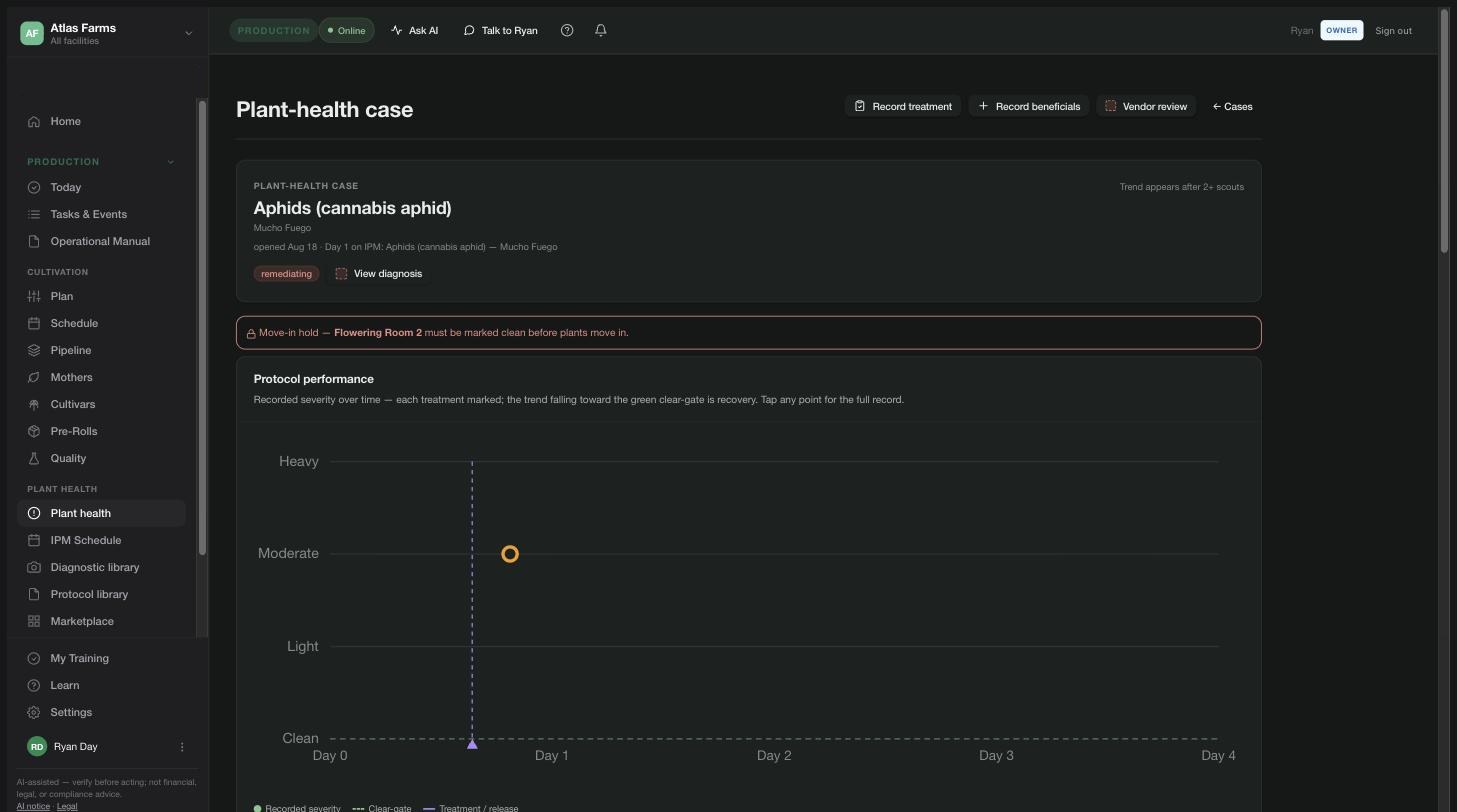
First treatment marked on the trajectory, severity recorded Moderate on the walk, the green clear-gate waiting below — and the room itself now holds a move-in freeze until it’s marked clean. Scheduled health checks keep scoring it; sticky-card counts and photos land as comparable frames, first versus latest.

The case ledger on Day 1 — protocol performance chart with the first Moderate severity point and the treatment marker against the clear-gate line, and the move-in hold banner: Flowering Room 2 must be marked clean before plants move in

The trend earns itself. Two or more scouts draw the line; each treatment is marked; the trend falling toward the clear-gate is recovery, and clearing is trajectory-gated — never declared by hand.

7.0 The specialist

Not clearing? Loop in a vendor.

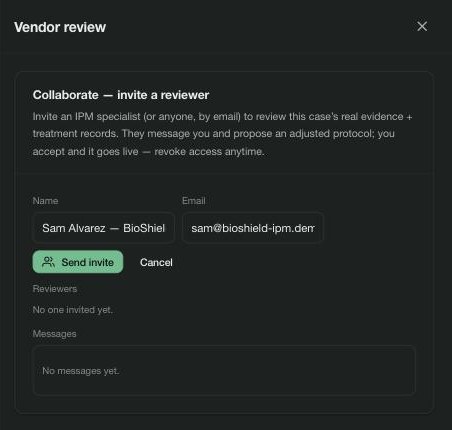
Invite an IPM specialist onto the case by email. They see the real evidence and treatment records — nothing else — message you in the case thread, and propose an adjusted protocol. You accept and it goes live as the new version of the SOP; access is scoped to the one case and revocable anytime.

Vendor review on the case — collaborate, invite a reviewer by name and email, with the reviewers list and the case message thread below

Versioned like everything else. The vendor’s proposal arrives in the thread; acceptance pushes it as a new SOP version, and every earlier version stays reviewable.

The Marketplace, Vendors tab — vetted IPM specialists with specialty tags, product lists, and an Invite-to-a-case button on every card
7.1 The marketplace

Proven protocols, one click from running.

The SOP Store carries protocol packages — SOP, schedule, checklist, and compliance rules in one install, every product MDARD-listed. It lands as a fully-editable SOP you own and, with a schedule, a live protocol that runs immediately — and drops straight into an open case. Vendor-submitted protocols queue for your approval before they ever list.

The SOP Store — installable protocol packages including IPM Scouting and Monitoring and Powdery Mildew First Response, each listing what it installs: SOP plus schedule plus checklist plus compliance rules, all products MDARD-listed
The IPM Scouting and Monitoring package after one click — Installed, with Open schedule and one install counted

One click, verified live. This install happened while building this page — the scouting package landed as “Weekly IPM Scouting,” SOP plus weekly schedule plus four-field checklist, confirmed by a manager and deriving floor tasks the same day.

Most software stops at the diagnosis. Cannvas prices what the problem cost you.

8.0 The price of delay

"What did the aphids cost me?" Answered in dollars and grams.

When a case clears, the efficacy engine compares affected sets against the cultivar's own baseline — yield, grade mix, quality — and prices the damage. The protocol that cleared it reattaches to the diagnosis, so the next case starts with the answer.

0%
flower yield on affected sets vs the cultivar's own baseline — the aphid case, priced
CAUGHT
Day 0
Flagged on a routine floor walk — while she was still in the room.
CLEARED
Trajectory-gated
A case closes on recovery evidence over consecutive checks, never on a calendar date.
NEXT TIME
Instant replay
The protocol that cleared it is attached to the diagnosis — activation is one approval away.

Causal humility, by design. Cannvas reports what changed against the baseline and what was done — it cuts recurrence, it doesn't promise cures.

Your sensors see the room drift. Cannvas runs the response — and prices the damage.

Preventive by calendar · evidence-graded diagnosis · protocols to the floor with REI lockouts · every case priced against the baseline.

30-minute demo · or the full system on your data, free for 14 days.