Compliance is a system, not a concept.
Nobody runs a 100% compliant facility — not because operators don’t care, but because compliance has always been a binder on a shelf and a hope. Cannvas makes it a system: every issue flagged with the rule it violates and the dollar amount it carries, every fix a step in work the floor already does. Issues get caught before they become citations.
Your SOPs stopped being paperwork. The rules made them your operation.
Michigan’s rules don’t just require a binder — they require the binder to be true. SOPs must be on site, current, and must detail how you actually operate in compliance with the rules; an SOP that doesn’t match your practice is, by rule, an inaccurate SOP — correctable immediately, updatable within one business day, and finable. That’s the mechanism by which every licensed grow and processor is asked to prove they run the facility exactly as written. Cannvas is built for exactly that standard of proof.
| The rule, verbatim | Cite · guideline fine | How Cannvas answers it |
|---|---|---|
| “A marijuana business must have up-to-date written standard operating procedures on site at all times.” | R 420.206a(1)$2,500 | The Operational Manual is the binder — versioned, current by construction, retrievable in seconds. |
| “Standard operating procedures must detail the marijuana business operations and activities necessary for the marijuana business to comply with the acts and the rules.” | R 420.206a(3)$2,500 | The compliance-mapped standard binder + the coverage audit: every required subject governed by a document, gaps named with the fix. |
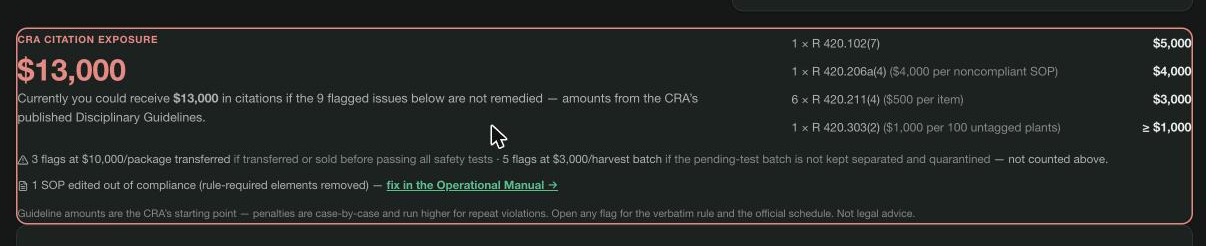
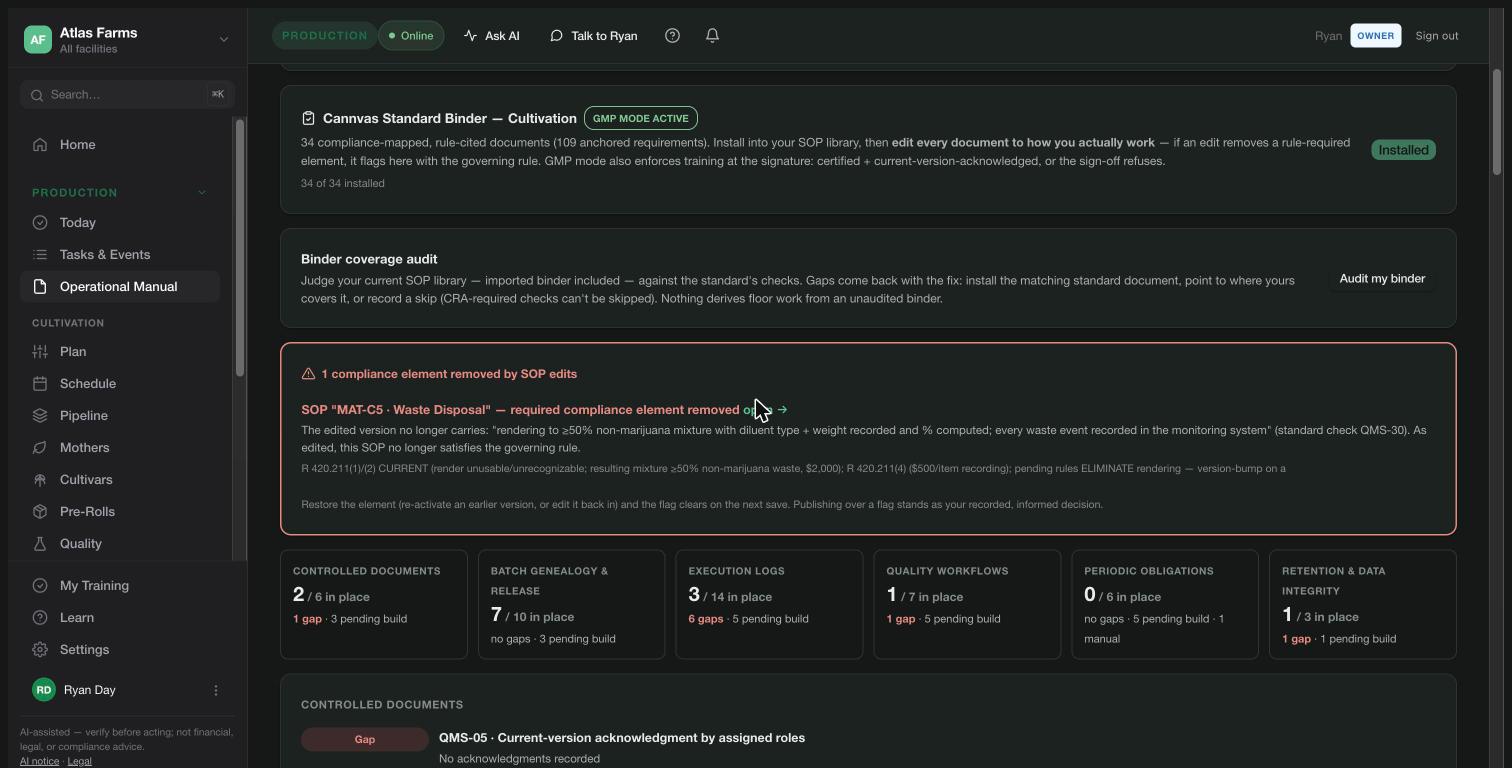
| “If the agency determines that any standard operating procedure contains inaccurate information or does not comply with the rules… the licensee may be required to correct the practice immediately and update the standard operating procedures within 1 business day.” | R 420.206a(4)$4,000 | Edit-drift flags: change a standard-binder SOP out of compliance and it flags with the governing rule — before an inspector determines anything. And because SOPs derive the floor’s tasks, procedure and practice can’t silently diverge. |
| “A marijuana grower must accurately enter all transactions, current inventory, and other information into the statewide monitoring system as required in the rules.” | R 420.102(7)$5,000 | Record-divergence flags: unrecorded harvests, phase moves, over-capacity rooms, short receipts — caught daily, priced, with the Metrc fix steps. |
| “A marijuana business producing marijuana products shall maintain records of formulation and make them available to the agency upon request.” | R 420.206(12)$10,000 | Records of Formulation can be kept as controlled documents in the Operational Manual — versioned, available on request. |
| The CRA’s published fine schedule — the Disciplinary Guidelines (updated July 2026). | Official schedule | The source of every dollar amount on every flag — quoted verbatim, with the official document one tap away at the exact page. |
The CRA’s next rule set — approved through state review in May 2026, awaiting final adoption — goes further: federal food-safety practice (21 CFR 117) becomes mandatory for licensees · processors must not just maintain but adhere to their records of formulation · grower staff need Master Grower and pesticide-applicator credentials within a year · monthly revenue reconciliation, twice-yearly physical inventory audits, per-batch expiration dates, and records kept electronically available on site all become rule · and the agency gains authority to issue updated standards with a six-month compliance clock. Cannvas is building to that floor now — so when it lands, our orgs are already standing on it.
Data entry isn’t compliance.
Most “compliance software” makes recording easier — scanning, syncing, tidy data entry. Useful, and still blind: it can’t tell you what’s wrong. Cannvas reads what your records actually say against what the rules actually require, and flags the difference with the rule and the dollar attached. Easier record-keeping is a convenience. Knowing what an inspector would find — before they do — is a system.
Every flag carries its price.
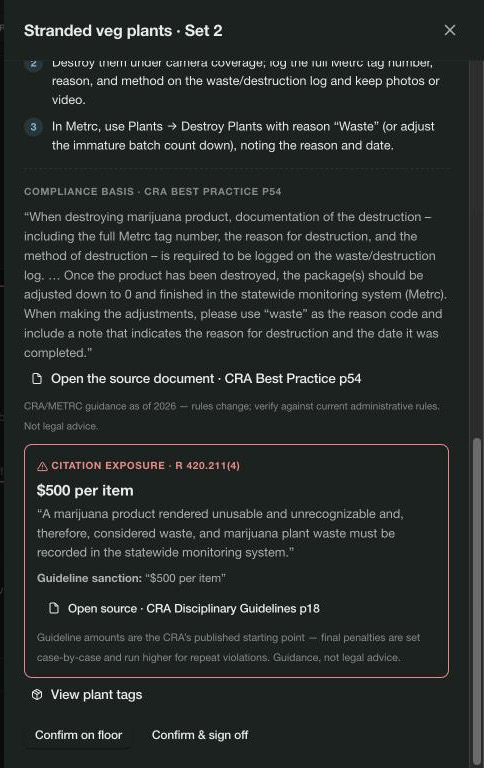
Cannvas reads your operation against the CRA’s own published fine schedule — the official Disciplinary Guidelines, cited verbatim. The production Today page carries the number that matters: what you could receive in citations if the flagged issues stand. Every individual flag shows its rule, its dollar amount, and the exact steps that clear it — with the source document one tap away, open to the right page. A flag with a price on it gets fixed as a priority, not an afterthought.
Cannvas flags compliance issues to you. It never reports them to the CRA or any regulator.
Not to the CRA. Not to any agency. Your operational data works for you — flags exist so issues get fixed before they become citations, not so a regulator hears about them. If a regulator ever sees your compliance dashboard, it will be because you chose to show them. That’s the whole design: the operators we build for don’t drift out of compliance on purpose — they just never had a system that caught it in time.
A binder the floor actually runs — because it becomes the work.
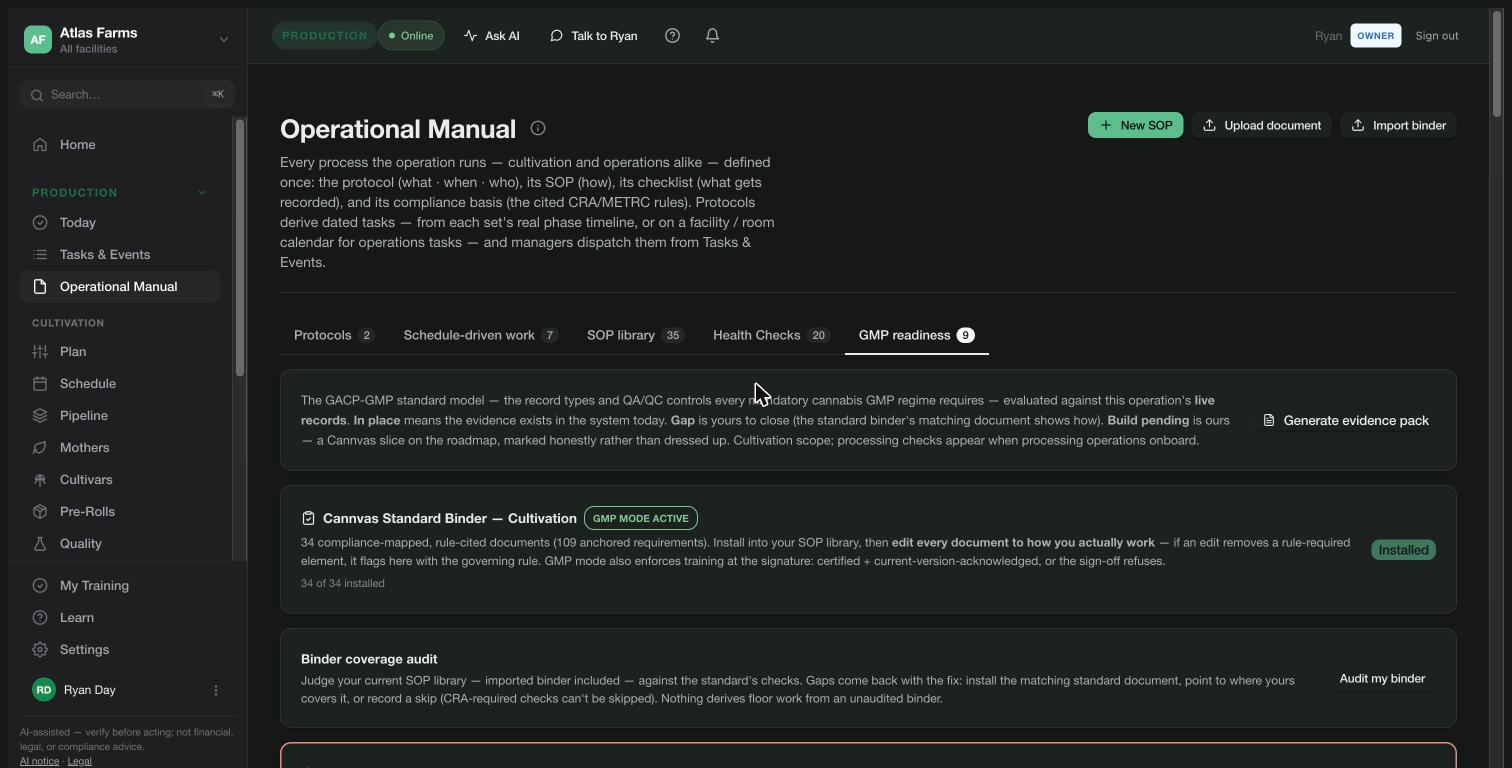
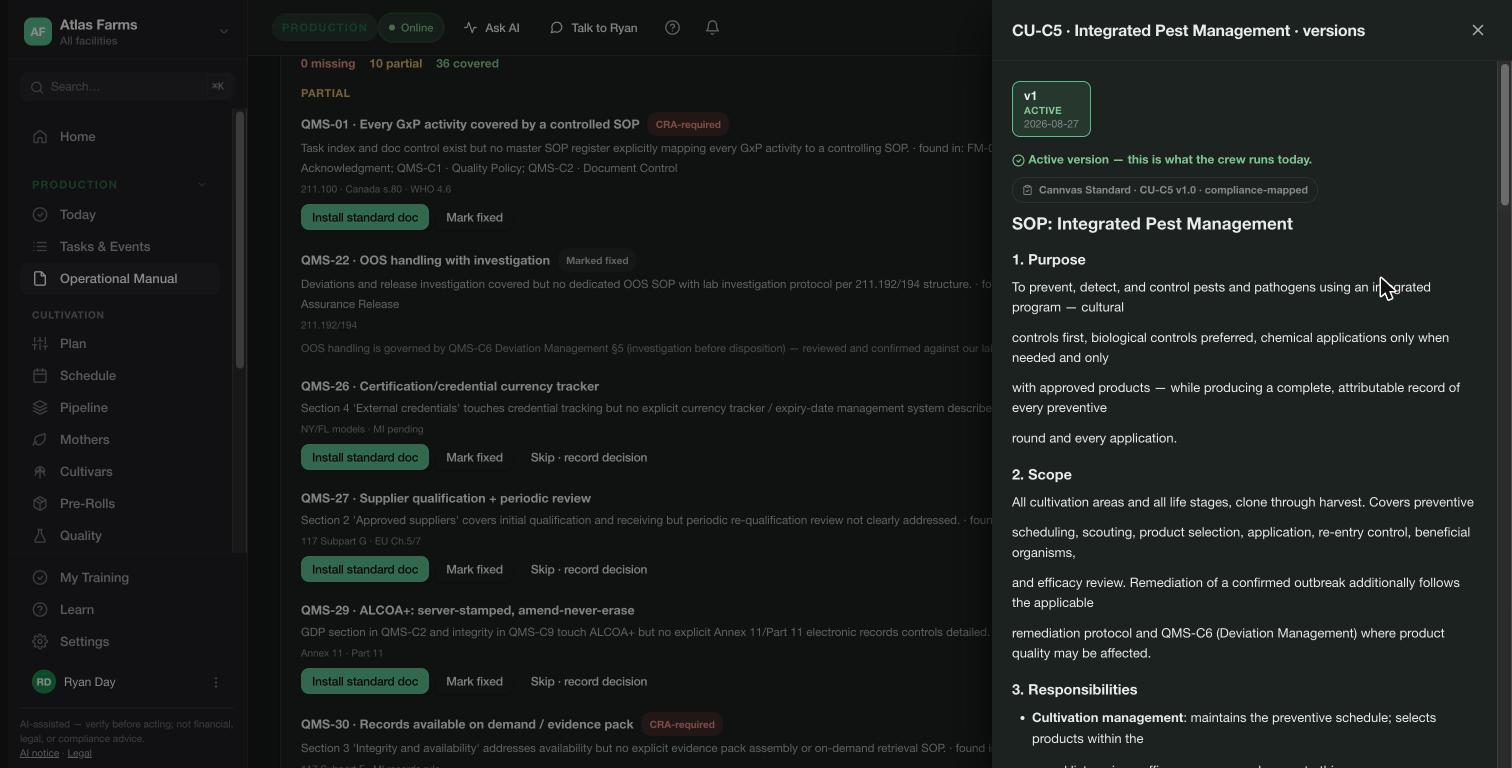
Every licensed facility owns an SOP binder. Almost none of them run it — it satisfied an application requirement, then went on a shelf. Cannvas ships a compliance-mapped, rule-cited standard binder that installs into your Operational Manual. You edit every document to how your operation actually works — your rooms, your products, your people — and the accepted version is what derives the floor’s daily tasks. Having the binder and following it become the same act. And if an edit removes something a rule requires, it flags immediately: the rule, the dollar amount, the fix.
The SOP becomes the checklist. Automatically.
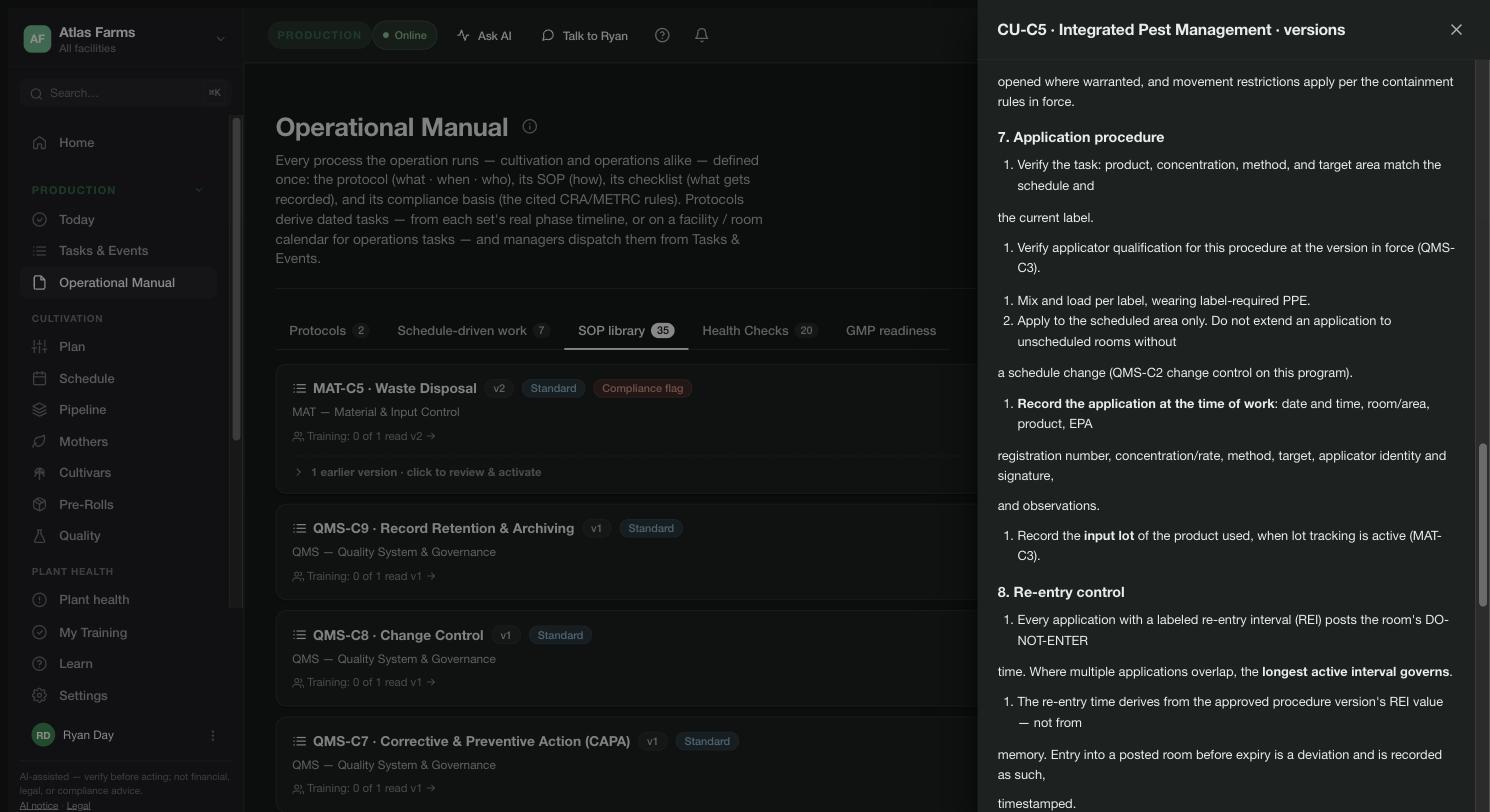
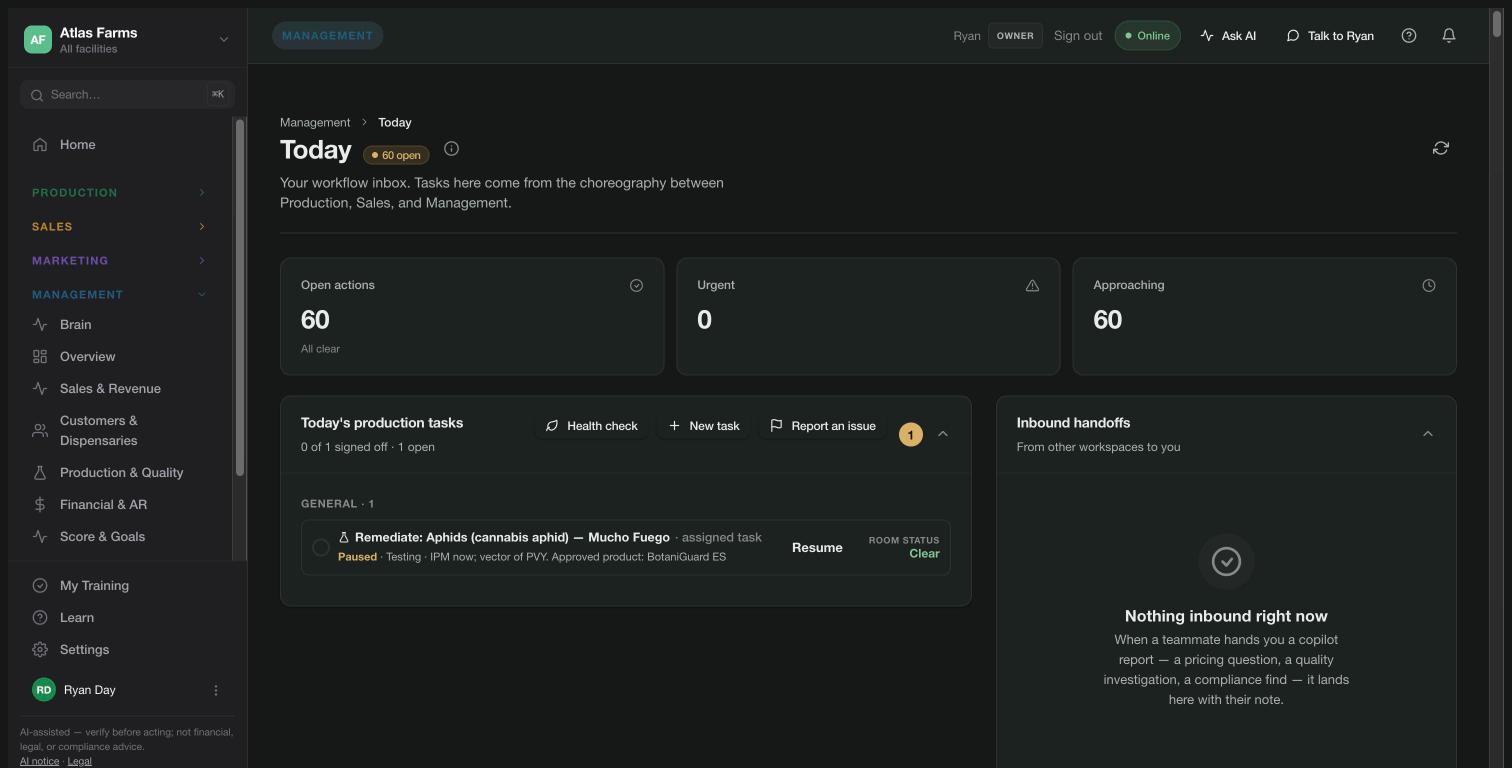
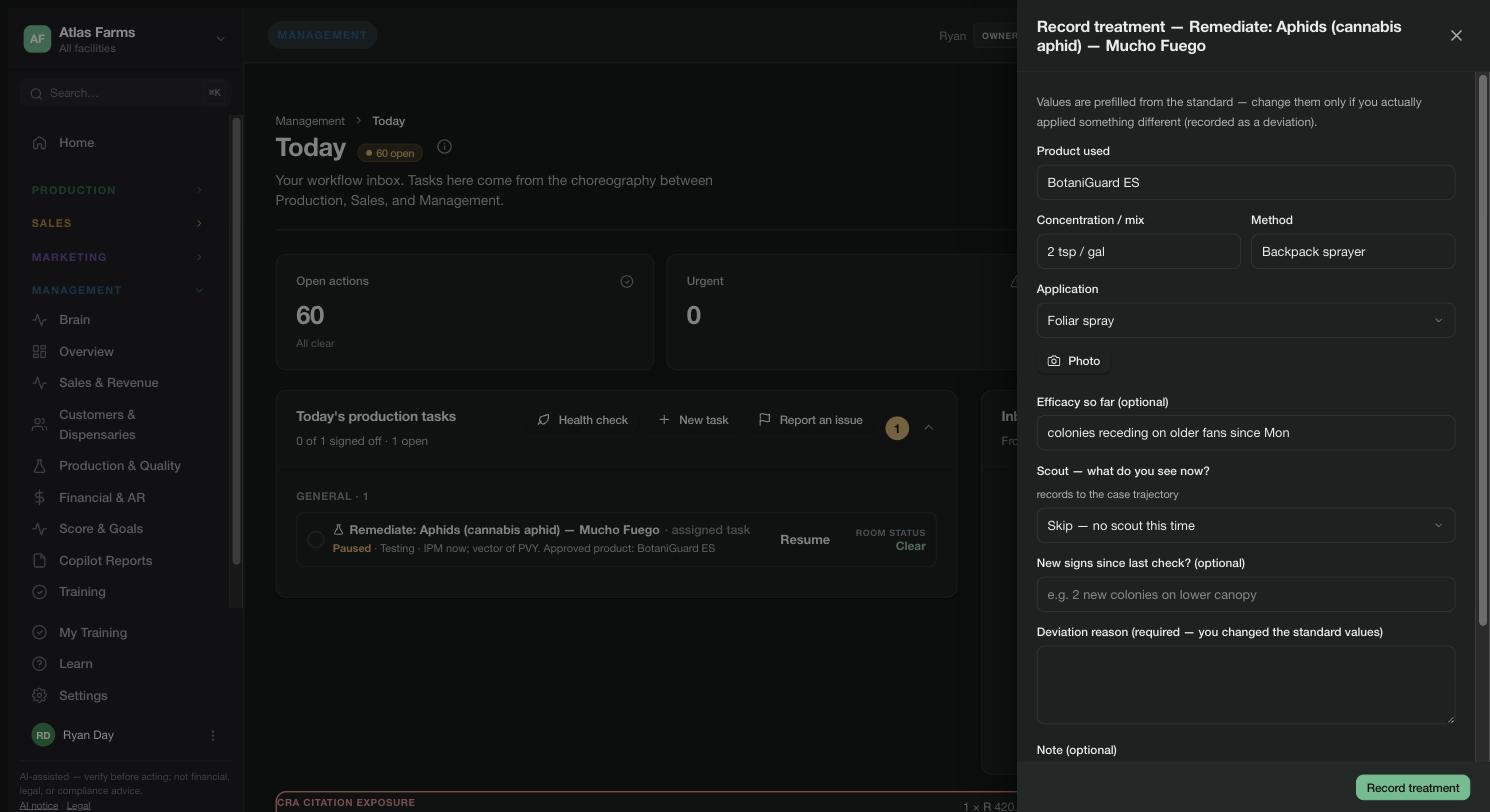
This is where every other compliance product fails: the procedures live in one place and the work happens in another. In Cannvas, the accepted SOP derives the daily work — its steps become the checklist, its cadence becomes the schedule, and its record requirements become the fields the floor fills at the measurable steps. Your team doesn’t study a binder; they open Today, follow the steps in front of them, and record where the procedure says to record. Sign-offs are server-timestamped against the exact SOP version on screen. Compliance stops being something the floor has to know — it’s just how the work arrives.
Already have a binder? We’ll tell you what it’s missing.
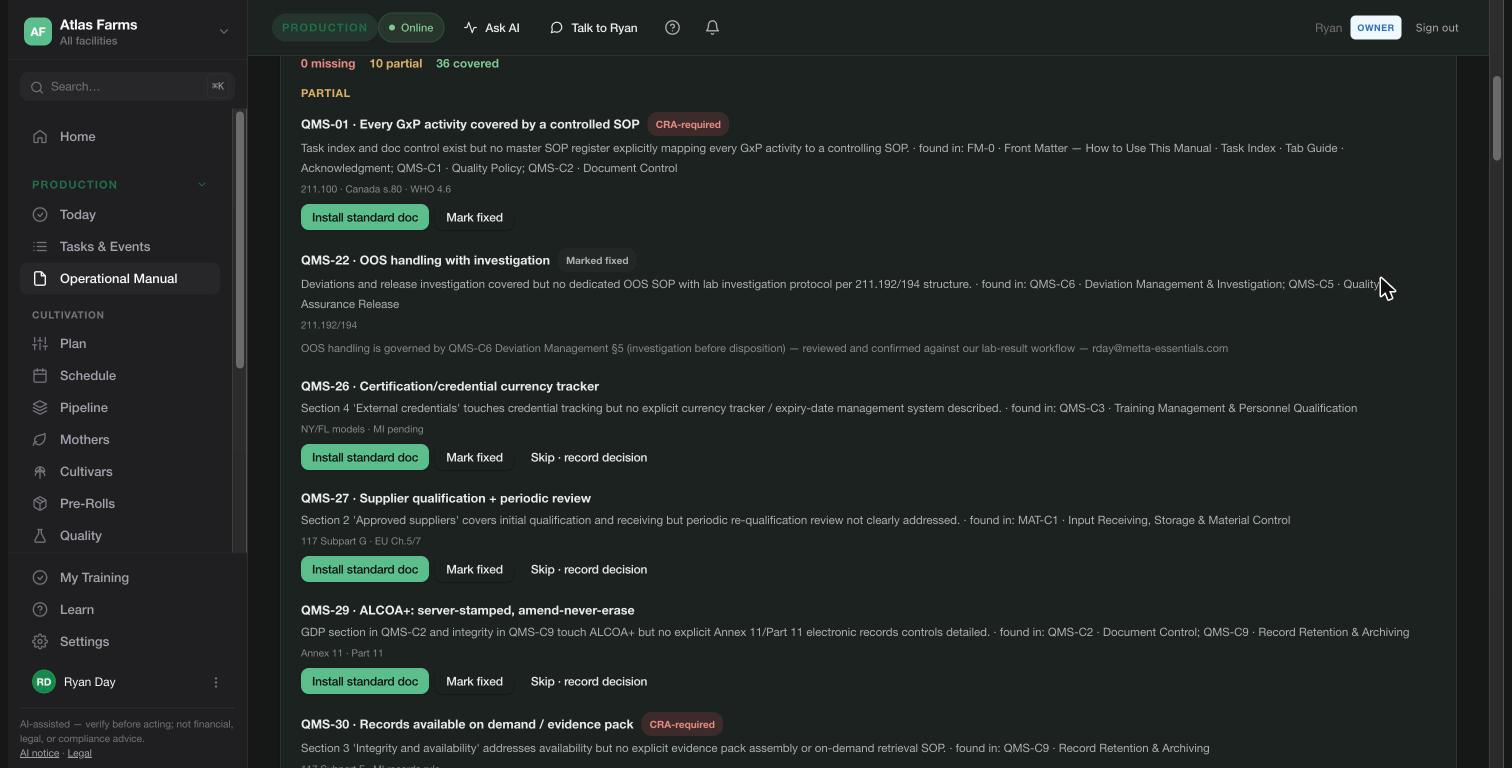
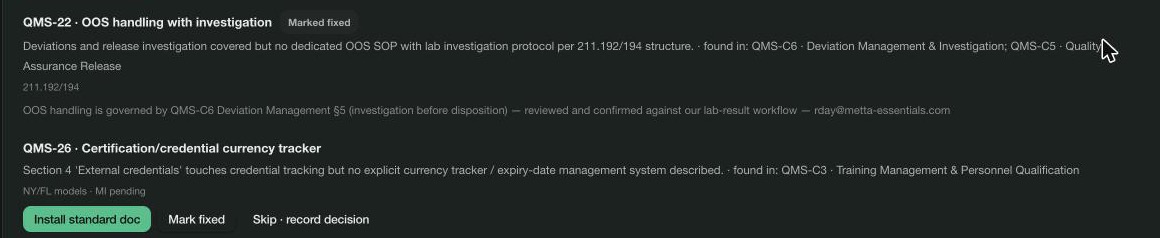
Import your existing binder and Cannvas audits it against the checks inspectors actually look for — document by document, requirement by requirement. Every gap comes back with the answer attached: install the matching standard document, point to where yours already covers it, or record a considered skip. Requirements that reflect current CRA rules can’t be skipped — only fixed. Nothing reaches your floor from an imported binder until a manager confirms it, and the audit itself becomes a record: your starting posture, and every gap closed since.
Proof isn’t a scramble. It’s a button.
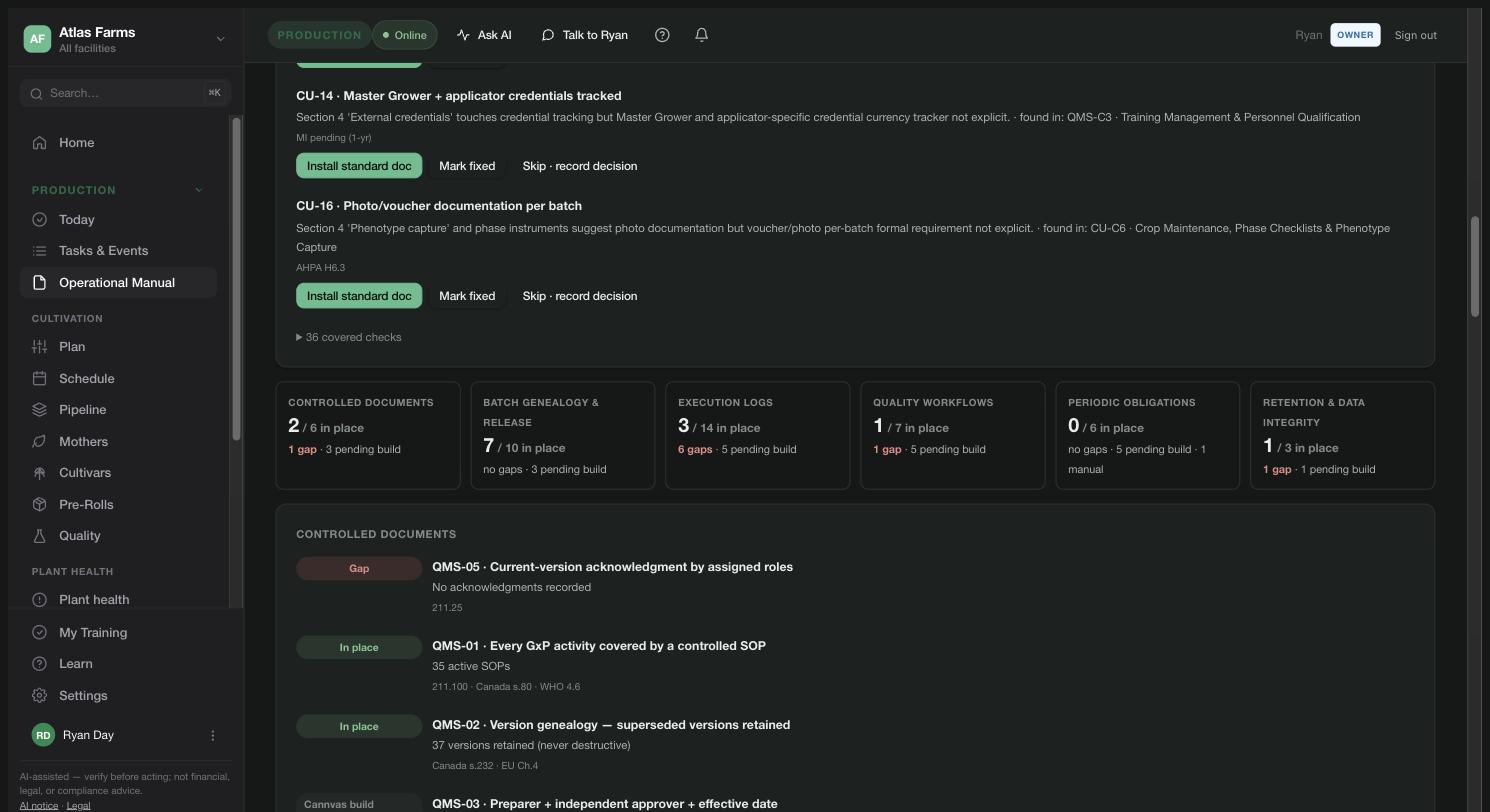
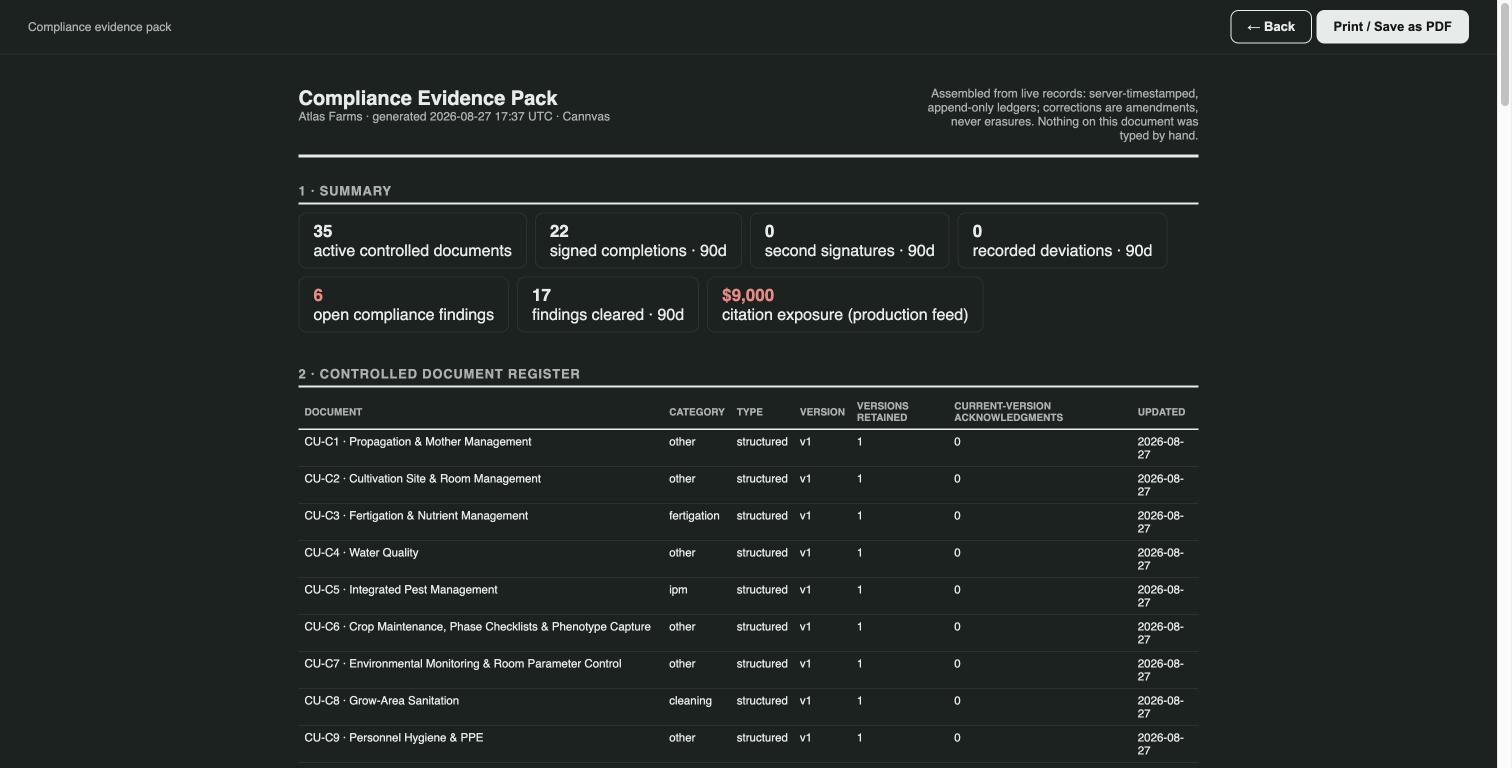
Because the floor’s daily work runs through the system — sign-offs server-timestamped, records append-only, corrections kept as amendments — the evidence of compliance generates itself. A readiness scorecard shows where you stand against the standards certification bodies audit. And the evidence pack assembles the whole story on demand: document register, training matrix, findings history with every fix on record, and an integrity statement an inspector can test. No extra workload — structured guidance on the work your team already does every day.
The law is the floor. GMP is the system above it.
Compliance — the CRA floor
- Every compliance flag, priced — the Today exposure card and per-flag dollar amounts from the CRA’s official schedule
- Verbatim rules on every flag — with the official source document at the exact page
- The binder coverage audit — with CRA-required standard documents one click to install
- The readiness scorecard and the fix steps on every flag
GMP Quality — the pharma-grade standard
- The full standard binder — 34 compliance-mapped documents installed and edited to your operation
- Edit-drift flags — any change that breaks a rule-required element flags with the rule and the dollar
- GMP mode — sign-offs on qualified processes require certification and current-version acknowledgment, enforced at the signature
- The evidence pack — the audit-ready bundle, generated on demand
- Built on the certification standards — WHO+AHPA GACP and 21 CFR 117 structure, so running it is preparing for certification
Cannvas provides compliance tooling and cited guidance, not legal advice. Guideline amounts are the CRA’s published starting points; final penalties are determined case-by-case.
Catch it before it becomes a citation.
Watch the system run on live demo data — the flags, the binder, the audit, the evidence.